Showing posts with label gold reserves. Show all posts

Thursday, April 30, 2015

Increasing Oil Production in Canada Despite Price Plunge oil sands, China Revises Gold Reserves renminbi

Like their Saudi Arabian counterparts Canadian oil producers appear to be concerned with maintaining their share of the market, even at the expense of earnings - At a time of record low realized prices, Canada exported a record 3.11 million barrels of oil in January - 13 per cent more than it did in January of last year, and 80% more than in 2010.
Even with a collapse in oil prices Canadian oil production - driven by activity in the oilsands, is expected to increase by 150,000 bpd this year and by that same amount again next year.  Canadian Association of Petroleum Producers

According to ARC Financial, the number of wells drilled in Western Canada will be down 50% this year as compared to last (5,300 vs 11,222).  Though production keeps rising, companies remain burdened with higher than acceptable costs.
- estimates suggest as many as 30,000 workers have lost jobs in Canada’s oil and gas industry since the downturn began last fall.

china, china imports, yuan, renminbi, renminbi yuan, renminbi exchange, currency swap, currency reserves, foreign exchange, gold reserves, china reserves, china disclosure, africa, china gold, china gold reserves,
Keeping production up when oil prices are down is much easier for Iran and Saudi Arabia to do than it is for their western counterparts
  • low-cost oil reserves in Saudi Arabia vs high cost reserves in Alberta (Alberta oil) and us shale (North Dakota shale)
  • Canada’s reserves may be as massive but they are much more expensive to extract from
  • This appears to have had more of an effect on producers south of the border (where shale exploration has officially stalled) than in Canada .. Canadian companies have huge cash reserves which they are they able to dip into when prices get too low .. and so they are able to fund core projects until new cost cutting measures take effect.


According to the latest quarters as of May 2015 company earnings are way down - earnings losses mount in Canada


Suncor Energy Inc (SU) -  1Q15 $(341) million loss or 24 cents per share vs $1.485 billion or 101 per share in the previous year.
Oil Sands operations production was 440,400 bbls/d in the first quarter of 2015, compared to 389,300 bbls/d in the prior year quarter, primarily due to minimal maintenance activities in the first quarter of 2015. Production highlights included 346,500 bbls/d of SCO due to strong upgrader reliability, and record production of 188,700 bbls/d at Firebag.  Cash operating costs per barrel for Oil Sands operations decreased in the first quarter of 2015 to an average of $28.40 per barrel (bbl), compared to $35.60/bbl in the prior year quarter, due to increased production and lower costs as a result of lower natural gas prices,Suncor's share of Syncrude production of 35,200 bbls/d in the first quarter of 2015 remained comparable to the prior year quarter production of 35,100 bbls/d.

UK has lowered its tax rate on oil profits made in the North Sea ! At suncor this saved the company $406 million (62-> 50%).


Cenovus Energy Inc (CVE) - Oil Sands production is up 20% (to 144,000 bpd) but the company endured a massive $668 million quarterly loss recently attributable to the decline in the realized price of oil and natural gas (-47% -> $37.66; -25%-> $4.47).  In the quarter just prior to this one the loss was $472 million.

Top Producers of Shale in North Dakota (Bakken)

  • Whiting Petroleum Co. (NYSE: WLL) - quarterly production 1.6 million barrels (19% of company production)
  • Continental Resources Inc. (NYSE: CLR) - 127,788 bpd
  • Hess Corp. (NYSE: HES) - 63,000 bpd (85% of company production)
  • Statoil ASA (NYSE: STO) - 50,000 bpd (9% of company production)


China Revises Gold Reserves (October 2015: China reserves)

- First time in four years China says anything about its reserves
- According to Wood Mackenzie China has 30,000 tonnes of gold, more than any other country.
Since the middle of the last decade China has been leading all countries in terms of gold output - very little of that actually leaves the country.. add to that the fact that China imports another 1000 tonnes of the yellow metal through various ports (HK being the largest) and you can start to see the potential it has to accumulate massive reserves.

  • Gold withdrawals from the Shanghai Gold Exchange hit a record high of 620 tonnes in the first three months of 2015. 
  • Private consumption in China is probably not that high meaning at least a portion of that is going to China's central bank.  Current estimates put China's reserves at just over 1000 tonnes, far behind the top four countries which have a combined 16,500 tonnes.

  • According to various sources out of China, the upcoming report will act to bolster China's currency - This gives foreign currency traders (and governments) more confidence in the yuan-renminbi as an alternative to the US dollar.

  • China and Brazil have already signed a $30 billion currency swap agreement.

Saturday, January 31, 2015

Reasons to Buy Gold and Silver in 2015: US Dollar, Currency Wars, Russian Reserves, Central Bank QE

Gold and Silver Market Ripe For Rapid Growth

Though stateside gold prices may appear docile, from a foreigner's perspective precious metal prices are already too high because in much of the rest of the world the key precious metals have become a lot more expensive to purchase thanks to currency wars : the mighty US dollar.

Seventy-five percent of silver production (mine production) happens at gold mines - this means that, when gold production slows down (companies shuttering mines which started happening in the middle of last year) silver output declines.  This keeps the gold silver ratio intact despite the delinking of the two metals at London's commodities bourse.

The core price is set by comex, the commodities exchange in NYC and thus is traded in USD.
The fact that the price of both pcm's has barely increased over the past six months in my opinion makes both ripe for the picking ! 
Elsewhere the strong US dollar is making gold increasingly harder to afford, but that's inflation spurred by changes in local currency rates;  though quantitative easing and changes in interest rates are wreaking havoc on other currencies, the USD already has that factored into its value.. with The Fed at its side nothing aside from a shaking of the Fed's basic policy of money creation can shake its value... or of course a tiring by currency traders of the endless excuses for more QE.

In my opinion however, gold should've gained much more than nothing in US dollar terms.  Demand is still rising especially among those seeking a tangible hedge against inflation, as well as by those transferring money out of equities in response to growing global economic uncertainty, a shrinking middle class. 


The Gold Supply Problem


reasons to buy gold, investing in gold bullion, silver bullion, gold price, silver price, fx rates, foreign currencies, wars, rumors, russia central bank, russia gold, russia, china gold currency, china gold imports, festivals, india gold, switzerland, gold exports, us dollar, dollar index, deliveries, swiss gold, switzerland exports, swiss franc,
Now there's also the inevitable gold supply problem : let's face it, prices crashed last year - and the big producers responded by shuttering mines, big mines that weren't producing at reasonable cash costs.  Restarting those mines doesn't happen overnight - it can take years to complete new shaft reconstruction, bring in the necessary capital investment funding, and in some cases may even involve reapplying for licenses and approvals.  The big gold companies are now worth a lot less making it increasingly difficult for them to get banks to lend them the billions of dollars needed to make the mines work.  Then of course there's the shareholders who need to be convinced that the metal prices won't collapse again.

As of 2014 there is an estimated 24 billion ounces of silver existing in the form of jewelry.  Total historic production of silver is about 52 billion ounces, eighty percent of that mined since the dawn of the twentieth century.  However, much of the 52b oz will never be available to the bullion market due to its historical value (in the form of religious items, museum pieces, non-scrap jewelry).

India Imports Record Amount Of Gold From Switzerland

According to data from November 2014 Indian imports of gold from Switzerland totaled CHF2.9 billion up a whopping 600% versus the previous year; it's not just that month either, in October it was up 280%; January through November gold imports amounted to 457 kilos.

Russia Continues To Add To Gold Reserves
Russia purchased 20.73 tonnes of bullion in December - note also that in December gold prices were up for the first time in five months (+1%).  Makes Russian reserves fifth largest at 1210 tonnes.
Also notable - Ukraine held onto its reserves after selling 16 of 40 tonnes in Oct/Nov. 

Then there's the other central banks who cumulatively only became net buyers of gold since 2010 after 20 years of being net sellers.

Russia is key here - July through September 2014 it accounted for 59% of the 92.8t of net gold purchases by central banks.  Gold comprises just under 11% of Russian reserves up from 8% in 2013.  Those purchases allowed it to leapfrog China (1150 vs 1054).
Gold imports from HK by China were down last year but it was still the second highest on record at 813 tonnes.  Demand for gold should continue to increase into February as a result of Chinese new year festivities.

Don't Bet Against The Canadian Dollar !

I don't consider the current CDN/USD fxrate to be sustainable -  Beginning in 2016 oil prices are forecast to go up possibly by as much as 50% ($45->$65 per barrel).  Also note that Canada's federal government is starting to run a balanced budget while the USA has a severe, structural deficit which ultimately will lead the United States into a situation where it will be forced to run up high payments to foreign bondholders further weakening its long term outlook.

Don't Let Yesterday's Gold Selloff Turn You Off

- gold responds positively to durable goods numbers
- most global currencies are either under pressure (canada, australia, euro) or being deflated (asia) - this strengthens the US dollar in the near term but makes it increasingly vulnerable over the long term
- when the dollar shows any sign of weakness expect a big jump in precious metal prices
- Greek debt bailout 80 out of 240 billion is owed to Germany - If Greece doesn't pay up Germany will undoubtedly rethink its financial obligations to the Eurozone and that weakens Europe, its central bank and its structure.

Tuesday, April 30, 2013

Gold Demand Remains Strong Despite Dip In Price (China, ETF, jewelry, bullion, central banks, supply)

     
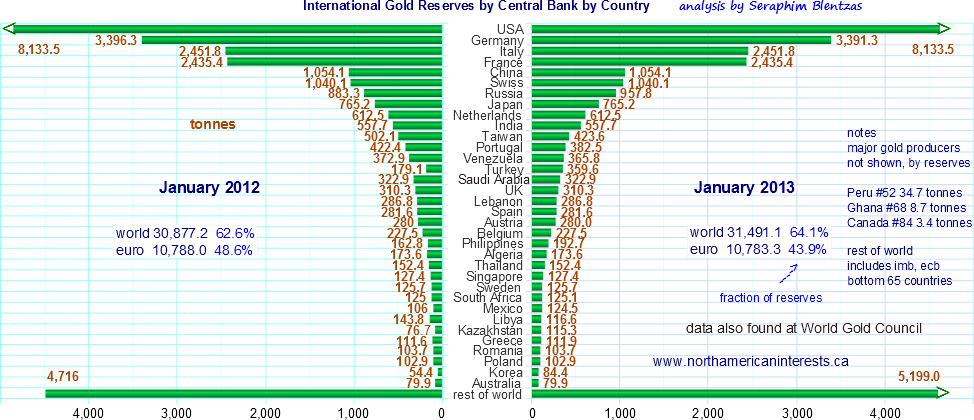
          Between January 2012 and January 2013 central banks showed an insatiable desire for gold !   Even though prices weren't as high as they were in 2011 ($1895 in September 2011 vs $1780 September 2012) they were high enough as to give holders of the yellow metal a unique opportunity to sell at a generous price. 

So did debt laden countries sell ?  NOPE !  in fact just the opposite happened:
Italy kept its reserves stable at 2451.8 tonnes but because its total reserves fell slightly the % of reserves represented by gold went up from 71.0% -> 72.5%. 
Holdings by Greece actually went up 0.3 t to 111.9 tonnes which means gold now represents 82.7% of reserves up from 81.5% last year.
 Spain 29.7% -> 30.4%        281.6 tonnes ranks #18 globally
 
more information about gold reserves at International Gold Reserves by Country


China The Sleeping Giant


Though officially no significant movement was made by the Chinese, the world's second largest economy has routinely showed interest in boosting its reserves.  $3.3 trillion is in American dollars but the gold that it has is only worth around $50 billion (at a spot price of around $1500 an ounce). 

China has been the leading gold producing nation since 2007, at 370 tonnes in 2012 (+15t), its output is about the same as Russia and South Africa combined.  Because most of the gold is mined at many small operations by minor companies, it's not so easy to keep track of where all that gold ends up.  Taking into consideration the large number of nationalized companies in China and that almost none of China's gold output makes it out of the country, it's possible that Chinese reserves are higher than officially stated.  The only incentive China would have to not disclose the actual amount is to keep the price relatively stable, since skyrocketing gold prices would wreak havoc to their consumer market (jewelry demand alone is 265.5 tonnes, more than total US consumer demand in 2012).
America's excessive printing of money is another reason China needs to diversify out of the US dollar.  Gold represents only 1.7% of China's reserves compared to 64.1% average for all other countries (up from 62.6%).  To put things into perspective, if China's gold represented the same fraction of total reserves as US holdings do, China would have 5.8 times as much gold as the United States (47.2 tonnes).

Gold Demand for jewelry (-3.2%), bullion (-17.1%) down in 2012 but demand by central banks (457 -> 535t), ETF's (185 -> 279t), and China (779.8 -> 776.1t) remains strong.


Countries More Picky About Where Gold Is Stored

Germany announced earlier in 2013 that it wants to repatriate 674 tonnes of its reserves from American (300 tonnes) and French (374 tonnes) vaults.  Other countries such as Switzerland are also thinking about doing the same thing.  Switzerland has 20% of its reserves in the UK, 10% in Canada; Switzerland did this originally as a way to keep its gold safe during war times.

Friday, October 5, 2012

Seabridge Gold (SA) Hecla Mining Company (HL) May Draw Interest; reserves,production,mining


                      Seabridge Gold (tsx:sea) and Hecla Mining Company (nyse:hl) are two companies that investors can't seem to figure out.  Prior to the temporary shutdown of Lucky Friday, Hecla was one of if not the largest pureplay silver producer in the United States.  After the Lucky Friday incident, investors fled the company resulting in an immediate loss of 30% of its silver output, half of its lead output and some of its reputation.  But today, Hecla is reporting not only that it will restart Lucky Friday within half a year but also that it will be expanding it with the construction of a fourth shaft which will lengthen mine life, possibly to 30 years.  With $233 million in cash equivalents Hecla is also active in the M&A department;  Hecla laid out $110 million for US Gold & Silver back in July 2012 (which was turned down).  The bad news for the company ?  Total operating expense last quarter was steady with the previous four quarters even though revenue was way down (averaged $108.105m over those quarters but just $67.02m in the last).  Not all was bad though, Hecla did manage to double dividends q2q (2c per share up from 1c despite eps being only 1c).

Seabridge Gold really is A gold mine !

According to the company's second quarter report it "will continue to advance its two major gold projects, KSM and Courageous Lake in order to either sell them or joint venture them towards production with major mining companies."  
Ivanhoe Mines potential ?
Ivanhoe Mines (now Turqoise Hill Resources) more than quadrupled in value after Rio Tinto took interest in it.  Whether or not Seabridge does the same the fact remains it controls 100% of what will someday be Canada's largest gold mine.
Three days after releasing the last quarterly report, on September 5, 2012 Seabridge released data from exploration drilling done last summer.  Drilling revealed veins with the highest gold grades found to date !  The findings are sure to bring KSM's 2P gold reserves closer to 40 million ounces (was 38.2m according to last estimate done).  Over the entire deposit, the average gold grade is 0.55 grams per tonne but at a 2 meter intercept, one of the newest holes drilled revealed 66.7 grams of gold per tonne in addition to 287 grams of silver !! (average grade over the entire hole was 8.94 g gold, 41.6g silver).
Seabridge also revealed that it is only focused on KSM and Courageous Lake which is why it's in the process of divesting all other assets (big chunk let go last quarter in Red Mountain Project) but don't be fooled into thinking it's letting go of all other interests;  When it sold Red Mountain and various Nevada projects, in addition to cash Seabridge Gold received more than 4 million shares of each company.  So, when those other projects pan out (no pun intended) Seabridge will realize even more in return not that it isn't already giving investors a healthy return (sept 5 - oct 4 : +15.05%, july 5 - oct 4 : +30.16%).  Bad News:  No production means no dividends.

Watch Out !  Seabridge Comes With Risks
Core assets Kerr-Sulpherets-Mitchell (BC) and Courageous Lake (NWT) are located in regions where aboriginal groups also have land.  The First Nations people could be entitled to key land and thus other agreements may need to be reached.  Shifts in political conditions and/or regulations (environmental laws, tax laws) could impact the company's ability to continue developing either project.  Right now though everything appears to be stable and, considering exploration at KSM has been ongoing for more than six years without any major disputes, I'd say the rewards outweigh the risks.
Notes:  Last quarter, cash resources declined by -$19 million due to advancements at KSM and Courageous Lake - Courageous Lake 2P reserves surpass 6 million ounces - All of KSM's 10.3 million ounces of proved reserves reside in the Mitchell open pit deposit (including probably it's 27.5m) - 10.2 million ounces in probable gold reserves must be mined from a block cave (Mitchell 7.4m, Iron Cap 2.8m) - Iron Cap is the newest of the four deposits (added May 2011).

Hecla Mining Company

      Hecla stock price has been on the upswing since September 13, 2012 (+10% that day while adding modestly to that gain since then).  On August 7, 2012,  the week before it acquired an interst in Dolly Varden Corporation, Hecla Mining Company reported on the 1st half / 2nd quarter of 2012.  The results were mixed;  On the one hand Greens Creek produced less: 1.365043 million ounces of silver down from the previous year (1.5m ounces), steady with the previous quarter (1.328704m oz) while on the other hand the cash cost per ounce of silver produced was down significantly from the prevous quarter ($2.24 --> $1.03 /oz).  So why the 49.7% q2q drop in gross profit ?  A couple reasons;  Average realized silver price down -26.1% between last two quarters (1st and 2nd) $36.59 --> $27.05.  Production was steady but payable ounces was not;

Payable silver sunces sold: 1,133,764 oz (-39.7% vs 2q11, -20.6% vs 1q12).  Gold, lead, zinc

Tuesday, September 20, 2011

Since 2001 The Price of Gold Is Up 600% linked To Central Bank Purchases & Investment Related Demand, overall Net Hedging by Mining Companies Up Only Twice in Last Five Years (quarterly)

   Since April 10, 2001 when the price of gold hit a low of about $256/oz it has been steadily increasing on the back of higher investment related demand (represented 37% of total demand in 2010 up from just 4% in 2000), higher overall demand (3,812.2 tonnes 9% higher than 2009), and greater interest shown in the yellow metal by Asia (China's demand for bars and coins accounted for 13.5% of all gold demand by value, that's up 70% in just one year). (World Gold Council) Jewelry accounts for roughly 50% of gold demand down from 85% in 2000 but up from 43% in 2009. In the first quarter of 2011 Chinese demand for gold (25% of all gold demand) exceeded demand from Indians (23% of global gold demand) who were previous to that the largest consumers of gold (90.9 metric tons compared to India's 85.6 metric tons, China's represented a doubling over the previous year) (China Is Now Top Gold Bug); In 2010 consumer demand in India led all countries, it accounted for 25% (963.1 tonnes) of all global demand for gold, that's up from 16.6% the year before. In other countries like Greece, economic turmoil is causing demand for bullion to spike. (Financial Times: Greek savers rush for gold)

China: If, as many suggest, the People's Republic of China lets the RMB increase in value relative to the USD, that will weaken demand for gold in the short term as investors see the new exchange rate as a sign of economic stability but in the long run, the stronger RMB will increase Chinese demand for Gold due to its greater purchasing power. Also, a stronger RMB will raise Chinese import demand, indirectly propping up gold demand abroad too.

Because of weakened global reserve currencies (euro/usd) and a low portion of portfolios (1% but begining to show growth) and central bank reserves in gold (central banks sold much of their holdings in the early 2000's/since 2009 they have become net buyers) gold prices are in the midst of a long term upward trend. (Pierre Lassonde, Franco-Nevada) In 2009 central banks held 17.5% of all gold estimated to exist above ground (940M out of 5.5B ounces). As recently as 2005 central banks gold selling contributed as much as 14% of the gold supply. (Seeking Alpha: Gold Soars on Falling Supply and Rising Demand) In early to mid 2011, the central banks of Mexico (99.1 tonnes), Russia (41.8 tonnes), South Korea (25 tonnes) and Thailand (just over 9 tonnes) were among the largest buyers of physical gold. As of 2011 the world's largest exchange traded fund, SPDR Gold Shares ranks 6th among all entities in terms of its gold reserves, it owns 1213.9M tonnes of gold which is 4.5% more than China (1161.6M), 30.96% more than Russia (926.9M) and 97.5% more than India (614.6M). SPDR has just over half of all the gold held by gold etf's. (cnbc: The World's Biggest Gold Reserves)

While gold demand is rising from all areas (consumer, jewelry, central banks, industry: total up 9%) total supply is not (up only 2% in 2010) and that's putting even more pressure on the price. (http://www.gold.org/download/pub_archive/pdf/GDT_Q4_2010.pdf) Output from gold mining makes up about 60% of the supply (gold output from mining declined in the seven years leading up to 2008). Another reason to expect higher prices; Companies are closing their hedge books (Barrick Gold led the charge in 2009 it cost them $5.6B, AngloGold Ashanti in October 2010 after it raised $1.58B to close it, Kinross Gold removed 90,000 ounces hedged in the first quarter of 2011 however it was the only major company to do that in 2011). Total gold hedged by miners amounts to 4.88 million ounces (1Q 2011); The first quarter of 2011 was just the second of 21 quarters since 2006 to show any increase in net hedging. (Gold miners hedge in Q1, big sales unlikely: report) Also to consider, the ceo's of Newmont Mining and AngloGold Ashanti the second and third biggest gold producing companies, predict that gold will exceed $2,200 an ounce by 2012. (reuters: Mining CEOs expect gold prices to keep rising)

If, as Franco-Nevada suggests, Asian central banks increase their minimum weighting in gold to 15% another 17,000 tonnes would be added to demand over the next few years. Gold ETF's could hoard more gold too with interest in physical gold higher than at any point in their history (in the USA they only date back to November 18, 2004, StreetTracks Gold Trust exchange-traded fund but since then they accounted for 2,300 tonnes of net demand). Gold companies for the most part have wide profit margins making them popular among both institutional investors and others.

Monday, July 25, 2011

Performance of Gold Mining Stocks not Necessarily Correlated with the Price of Gold (last 2 months gold price is up over 14% but a basket of large/mid cap gold stocks is down 7%)

Gold stocks have decreased in value by about 7% over the last 2 months even though the price of gold has risen 14%. (Maison Placements Canada Inc.) Goldcorp and Kinross Gold both fell 4% in July 2011 even though the price of gold increased 14% (in Canada the S&P gold index only increased 8% during that time even though it hit a near term low prior to that). (globeandmail: Gold stocks still lag surging bullion price) Gold companies are playing catchup for a number reasons; Many of the established companies have dwindling reserves (annual production exceeds reserve replacement) which is one of the reasons behind declining global output (China is one of only a handful of countries that can be relied on for growth); Prior to the more recent spike in the price of gold (before 2009) gold production worldwide fell each year, from 2005 to 2009 consecutively meaning that record high gold prices are needed just to keep production steady (higher gold prices make new mine production easier to accomplish because cash costs don't need to be low for healthy margins to be realized) (Goldsheet - Historical World Gold Production) Over the long term, production has also been down in the established mining districts of South Africa and Canada. (Gold News:Gold Mining Decline) In September 2010 all of the world's gold stocks had a combined market value of US$ 360 billion, that compares to US$ 19 billion in 2000 (increase is due mostly to new mining companies entering the market; higher gold prices make even the highest cash cost operations economically viable).

There is optimism regarding production though. In Australia, Olympic Dam (BHP Billiton's trillion dollar gold/copper/silver project), Super Pit, Newcrest Mining's Cadia Hill (33 million oz of gold reserves) are well on their way to producing in the near future while in other countries that have exhibited falling production rates in the 2000's (Canada specifically), new projects at Detour Lake, Malartic, Kerr-Sulphurets Mitchell and Snowfield/Bruceback (88 exploration projects in British Columbia alone in 2010 with capex spending the sixth highest since 1991) have investors optimistic. (Mineweb: Officials believe one of the largest gold resources in the world lies within BC) Canada's biggest gold project, Kerr-Sulphurets-Mitchell (reserves at 39 million ounces for gold and 214 million ounces for silver) is estimated to have cash costs of only $105 for the first seven years, that's four times less than Goldcorp's cash cost which has the lowest among tier 1 gold companies; also four times lower than Yamana Gold's cash costs !
The reason for the 7% drop in gold stocks at a time when gold prices increased by double digits (%) is simple: Companies with declining reserves are looking to mine in high cash cost regions out of desperation (higher cash cost=smaller margins=market value of each ounce goes down). Newmont Mining is an example; though reserves have maintained growth the increases have been smaller [only about 1.6% growth in 2P reserves in 2010, 93.5 million from 92 million ounces versus 7 million between 2008 and 2009 (85 mil in 2008/92 mil in 2009], established companies like AngloGold and Goldfields have decreasing production rates while other companies like Kinross Gold have taken on lots of debt to make questionable acquisitions (by issuing paper, other examples are Barrick Gold's acquisition of Equinox Minerals). Smaller potential for cash cost improvements/production rates by established companies means the junior, relatively new players (like Eldorado Gold, Detour Gold, Osisko Mining) and others like Yamana Gold (undervalued because of past risks which have proven to be not a problem for the company, Yamana was up 13% in the month of July, being one of the only major gold players to record significant growth over that time (Newmont was flat while Barrick Gold was only 3.5% higher, Goldcorp and Kinross were flat) is where the highest growth rates (PEG Ratio, P/E ratio) will come from. In 2008 though, things were different; For most of 2008 when gold prices started their overall upward trend, it was the large cap companies that outperformed the small cap; the opposite was true in the summer of 2011 when gold prices broke through new levels, the change in behavior might simply be the result of a much higher support level for gold prices making high production costs less of an issue for startup companies (many more juniors entered the market in 2011 than in 2008). Goldcorp's largest gold producing mine Red Lake, is nearing the end of its mine life (about 700,000 ounces/year gone), but Goldcorp production will be maintained due to many other mines commencing (Penasquito, Mexico reached commercial production in late 2010; Pueblo Viejo, Dominican Republic; Cerro Del Negro, Argentina).
Another thing to consider is that there are some factors unrelated to stocks, which affect spot prices; For example in early August of 2011 (when there was a lot of economic uncertainty) gold and silver spot prices declined at the same time major stock indices fell by their largest margin since the 2008 recession, the commodities selloff was sparked by a margin call (temporary selloff due to traders being required to meet call options). On August 8, 2011 when stocks performed poorly, gold spiked again (gold is the first thing central banks/banks/investors hoard when they want a stable investment medium, also when banks realize they might have to fulfill their significant short positions) but don't be concerned about the more gradual silver increase (historically, silver has lagged gold (time) when increases occur; the reason is that banks and large investors tend to wait until gold gets too expensive before buying the white metal); also, when gold becomes more costly, jewelers and industrials turn to alternatives and silver is one of them. Also consider the gold/silver ratio which is 44 (August 8, 2011), much higher than the historic ratio of under 20.

Some interesting facts about gold: 3/4 of all the gold ever extracted from the earth was mined after 1910. South Africa was the largest producer in most years since that time. Switzerland was the last country to tie its currency to the price of gold (1999). Until May 2009, all the gold ever extracted amounted to 5,835,876,025.6 ounces or about 85% of an ounce per person (165,446 tonnes). Gold weighs 19.3 times as much as water, is even more rare than diamonds, never oxidizes (maintains its shine), and in its more natural form, is one of the softest metals. Web Directories