Showing posts with label Saudi Arabia. Show all posts

Thursday, April 30, 2015

Increasing Oil Production in Canada Despite Price Plunge oil sands, China Revises Gold Reserves renminbi

Like their Saudi Arabian counterparts Canadian oil producers appear to be concerned with maintaining their share of the market, even at the expense of earnings - At a time of record low realized prices, Canada exported a record 3.11 million barrels of oil in January - 13 per cent more than it did in January of last year, and 80% more than in 2010.
Even with a collapse in oil prices Canadian oil production - driven by activity in the oilsands, is expected to increase by 150,000 bpd this year and by that same amount again next year.  Canadian Association of Petroleum Producers

According to ARC Financial, the number of wells drilled in Western Canada will be down 50% this year as compared to last (5,300 vs 11,222).  Though production keeps rising, companies remain burdened with higher than acceptable costs.
- estimates suggest as many as 30,000 workers have lost jobs in Canada’s oil and gas industry since the downturn began last fall.

china, china imports, yuan, renminbi, renminbi yuan, renminbi exchange, currency swap, currency reserves, foreign exchange, gold reserves, china reserves, china disclosure, africa, china gold, china gold reserves,
Keeping production up when oil prices are down is much easier for Iran and Saudi Arabia to do than it is for their western counterparts
  • low-cost oil reserves in Saudi Arabia vs high cost reserves in Alberta (Alberta oil) and us shale (North Dakota shale)
  • Canada’s reserves may be as massive but they are much more expensive to extract from
  • This appears to have had more of an effect on producers south of the border (where shale exploration has officially stalled) than in Canada .. Canadian companies have huge cash reserves which they are they able to dip into when prices get too low .. and so they are able to fund core projects until new cost cutting measures take effect.


According to the latest quarters as of May 2015 company earnings are way down - earnings losses mount in Canada


Suncor Energy Inc (SU) -  1Q15 $(341) million loss or 24 cents per share vs $1.485 billion or 101 per share in the previous year.
Oil Sands operations production was 440,400 bbls/d in the first quarter of 2015, compared to 389,300 bbls/d in the prior year quarter, primarily due to minimal maintenance activities in the first quarter of 2015. Production highlights included 346,500 bbls/d of SCO due to strong upgrader reliability, and record production of 188,700 bbls/d at Firebag.  Cash operating costs per barrel for Oil Sands operations decreased in the first quarter of 2015 to an average of $28.40 per barrel (bbl), compared to $35.60/bbl in the prior year quarter, due to increased production and lower costs as a result of lower natural gas prices,Suncor's share of Syncrude production of 35,200 bbls/d in the first quarter of 2015 remained comparable to the prior year quarter production of 35,100 bbls/d.

UK has lowered its tax rate on oil profits made in the North Sea ! At suncor this saved the company $406 million (62-> 50%).


Cenovus Energy Inc (CVE) - Oil Sands production is up 20% (to 144,000 bpd) but the company endured a massive $668 million quarterly loss recently attributable to the decline in the realized price of oil and natural gas (-47% -> $37.66; -25%-> $4.47).  In the quarter just prior to this one the loss was $472 million.

Top Producers of Shale in North Dakota (Bakken)

  • Whiting Petroleum Co. (NYSE: WLL) - quarterly production 1.6 million barrels (19% of company production)
  • Continental Resources Inc. (NYSE: CLR) - 127,788 bpd
  • Hess Corp. (NYSE: HES) - 63,000 bpd (85% of company production)
  • Statoil ASA (NYSE: STO) - 50,000 bpd (9% of company production)


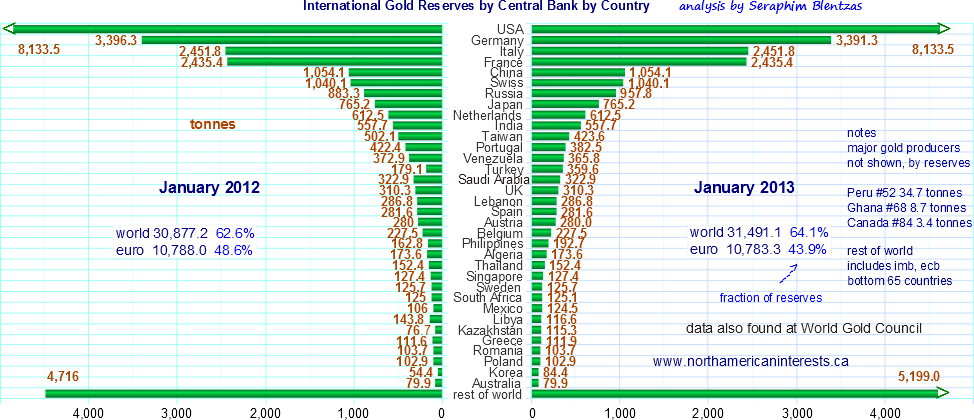
China Revises Gold Reserves (October 2015: China reserves)

- First time in four years China says anything about its reserves
- According to Wood Mackenzie China has 30,000 tonnes of gold, more than any other country.
Since the middle of the last decade China has been leading all countries in terms of gold output - very little of that actually leaves the country.. add to that the fact that China imports another 1000 tonnes of the yellow metal through various ports (HK being the largest) and you can start to see the potential it has to accumulate massive reserves.

  • Gold withdrawals from the Shanghai Gold Exchange hit a record high of 620 tonnes in the first three months of 2015. 
  • Private consumption in China is probably not that high meaning at least a portion of that is going to China's central bank.  Current estimates put China's reserves at just over 1000 tonnes, far behind the top four countries which have a combined 16,500 tonnes.

  • According to various sources out of China, the upcoming report will act to bolster China's currency - This gives foreign currency traders (and governments) more confidence in the yuan-renminbi as an alternative to the US dollar.

  • China and Brazil have already signed a $30 billion currency swap agreement.

Wednesday, January 25, 2012

Keystone pipeline rejection creates opportunity for Pacific Rubiales Energy, Oil Update (OPEC, refinery margins, oil prices, Gulf Coast)

     As promised, Saudi Arabia increased its crude output during the third quarter of 2011 bringing OPEC crude production up to 29.9 mbbls/d from 29.2 mbbls/d (opec implemented a 30m b/d cap a couple years ago). However, it wasn't enough to offset the 1.6 million barrels a day of crude lost due to the situation in Libya. Average WTI price fell from $102.3/bbl in 2Q11 to $89.5/bbl in 3Q11 meanwhile Brent Crude fell by only $3.6/bbl to $113.4/bbl, contracting the spread by $8.6/bbl.
A small increase in refinery margins boosted demand for oil by refineries. Margins dubbed crack spreads were at $6.8/bbl during the last three months (4Q) which is up from the previous quarter but still down from the previous year when they were $10.1. Refineries have responded to the marginal increases in the third and fourth quarter by increasing capacity: In the 3Q the following changes hapened: Repsol up 86,000 bpd, Port Arthur up 50,000 bpd, Brazil's Araucaria up 50,000 bpd. In Aruba, a 235,000 bpd refinery was reopened.

Refineries in the Gulf Coast the destination of the proposed Keystone xl pipeline, also receive regular bulk-cargo shipments of oil from Colombian producers like Ecopetrol (58% of exports in April went to the Gulf Coast/foreign investment limited due to state ownership however if you're from Colombia then I recommend taking advantage of the country's recent domestic sale of 10% of the company's stock) and Pacific Rubiales Energy (Toronto-based but Colombia-focused).  The Keystone Pipeline would carry 700,000 bpd of Albertan oil to refineries in an area known as Padd III where WCS oil commands higher prices than it does in Padd II due to a glut of supply there already (55% of Canadian oil goes to the Northern region Padd II due to its proximity to Canadian pipeline routes).

Some background on Pacific Rubiales Energy
Pacific Rubiales Energy produces castilla-blend crude, a commodity type that has seen its realized market price grow by 39% in the third quarter of 2011 to $93.87. Pacific Rubiales is a joint partner in Colombia's most lucrative oil fields at Rubiales & Quifa (gross production from the two areas combined is up 56.9% in the 3Q11 stemming from more than 27 successfull drills).
In just the last quarter, Pacific Rubiales sold 9,342,859 barrels of oil equivalent which is more than it sold during the entire year only a few ago (837,860 bbls is from purchases used in trading). New drilling at Quifa increased total daily production there to 40,000 barrels up from just over 3,000 bpd last year. Rubiales production hit a high of 190,000 bpd at the end of September 2011 up from the daily average of 125,145 barrels in the third quarter of 2010 (keep in mind that PRE's share is only 50% at Rubiales and 60% at Quifa; there's also royalties that bring the net production down slightly). The company has four other semi-major producing fields which produced at a rate of 12,752 bpd combined in the last quarter (up from 11,187 in 2010). One of them, the largest which is La Creciente is significant to the company because it is one of a few that is 100% owned. Total production at La Creciente was up 18.2% during the last quarter.

Risks associated with Pacific Rubiales - Union disruption at the largest fields Rubiales and Quifa cost the company 1,343,084 total barrels of output last quarter (491,933 net share after royalties). Each time a disruption takes place it takes the company a week to bring production back to normal levels. Also of note: due to higher royalties on higher production, PRE's net ouput share after royalties from the 60% owned Quifa field was only 1.77X La Creciente (19,241 vs 10,857) in 3Q11 despite avg total gross field production being 3.19X greater (35,222 vs 11,053). The OCENSA pipeline which Pacific Rubiales now relies on for most of its pipeline transport, is being blamed for soil, groundwater and crop contamination. That resulted a lawsuit against British Petroleum and Ecopetrol who built it back in 1997.

Positives - For the third quarter 2011 revenue increased by 103% qoq even though the price of oil only increased 42%. Net income per share was the second highest for a quarter in company history at 72c basic, 68c diluted. That compares to a 26c loss in the first quarter of 2011. Net revenue in the third quarter was $828,285 up 41.9% compared to quarter ended March. Quarter revenue was down, however from $957,509 in the quarter ended June, due to the price of oil being slightly lower.
In just the last quarter the company along with partner Ecopetrol (EC) built 4.4 km of new road and 30 new electical substations at Rubiales and 27.7 km of new road at Quifa. In addition Rubiales increased its water treatment capacity by 150,000 bpd to 1.8 million bpd. The company keeps breaking production milestones! Total production at all the fields it has a joint/controlling partnership in reached 239,000 bpd on November 7, 2011. In terms of public companies Pacific Rubiales is one of Colombia's fastest growing oil producers. On January 24, 2011 Pacific Rubiales Energy stock (TSX:PRE) was up 2.6%. By the end of the day the stock price was 37% higher than 1-year low. Its 50-day moving average is up 0.5% in just the last five days.

Why Pacific Rubiales matters to refineries in Houston
The Gulf Coast received four of the seven large cargos of oil exported from terminals operated by Pacific Rubiales Energy. That's nearly half of the 8.2 million barrels of oil that was exported (over 90,000 bpd), up significanty (just over 5.0m barrels exported in 2Q10) due to the increased oil output. With the crack spread recovering from early 2011 levels, refineries on the Gulf Coast of the U.S. are welcoming the increased supply. There's already a binational pipeline connecting Venezuela and Colombia meaning that Pacific Rubiales most likely has access to refineries in Venezuela too so there's nothing limiting demand as in the case with Canadian companies. Canada hasn't seen one new refinery built in the last 35 years/there is one however that's pending, it will be operated by Canadian Natural Resources. Also of note: In April, 58% of Ecopetrol's exports went to the Gulf Coast.

Mexico's Oil Reserves are falling fast
Through partnerships with Ecopetrol Pacific Rubiales is well connected. Ecopetrol accounts for 60% of Colombia's oil output, it also has pipeline networks throughout the country. Pacific Rubiales transports over 14,000 bpd by truck (that's growing) and as of October 21, 2011 Mexican trucks are allowed to cross over into the U.S.
Perhaps in the near future pipelines will be built to connect Colombia/Venezuela to Mexico considering Mexico's oil reserves are rapidly being depleted (down to 14.7 billion barrels in 2008 from 25 billion barrels in 1999, that's a 41.2% drop in only nine years!). In addition to that the oil field that used to account for two-thirds of Mexico's oil production in 2011 only accounted for about 25% (current production at Cantarell is around 900,000 bpd the lowest since the 1990's). I think that a pipeline connecting Mexico to Venezuela and Colombia will eventually happen. Could be a couple years could be a decade but it's not unfathomable.