Showing posts with label exploration. Show all posts

Thursday, April 30, 2015

Increasing Oil Production in Canada Despite Price Plunge oil sands, China Revises Gold Reserves renminbi

Like their Saudi Arabian counterparts Canadian oil producers appear to be concerned with maintaining their share of the market, even at the expense of earnings - At a time of record low realized prices, Canada exported a record 3.11 million barrels of oil in January - 13 per cent more than it did in January of last year, and 80% more than in 2010.
Even with a collapse in oil prices Canadian oil production - driven by activity in the oilsands, is expected to increase by 150,000 bpd this year and by that same amount again next year.  Canadian Association of Petroleum Producers

According to ARC Financial, the number of wells drilled in Western Canada will be down 50% this year as compared to last (5,300 vs 11,222).  Though production keeps rising, companies remain burdened with higher than acceptable costs.
- estimates suggest as many as 30,000 workers have lost jobs in Canada’s oil and gas industry since the downturn began last fall.

china, china imports, yuan, renminbi, renminbi yuan, renminbi exchange, currency swap, currency reserves, foreign exchange, gold reserves, china reserves, china disclosure, africa, china gold, china gold reserves,
Keeping production up when oil prices are down is much easier for Iran and Saudi Arabia to do than it is for their western counterparts
  • low-cost oil reserves in Saudi Arabia vs high cost reserves in Alberta (Alberta oil) and us shale (North Dakota shale)
  • Canada’s reserves may be as massive but they are much more expensive to extract from
  • This appears to have had more of an effect on producers south of the border (where shale exploration has officially stalled) than in Canada .. Canadian companies have huge cash reserves which they are they able to dip into when prices get too low .. and so they are able to fund core projects until new cost cutting measures take effect.


According to the latest quarters as of May 2015 company earnings are way down - earnings losses mount in Canada


Suncor Energy Inc (SU) -  1Q15 $(341) million loss or 24 cents per share vs $1.485 billion or 101 per share in the previous year.
Oil Sands operations production was 440,400 bbls/d in the first quarter of 2015, compared to 389,300 bbls/d in the prior year quarter, primarily due to minimal maintenance activities in the first quarter of 2015. Production highlights included 346,500 bbls/d of SCO due to strong upgrader reliability, and record production of 188,700 bbls/d at Firebag.  Cash operating costs per barrel for Oil Sands operations decreased in the first quarter of 2015 to an average of $28.40 per barrel (bbl), compared to $35.60/bbl in the prior year quarter, due to increased production and lower costs as a result of lower natural gas prices,Suncor's share of Syncrude production of 35,200 bbls/d in the first quarter of 2015 remained comparable to the prior year quarter production of 35,100 bbls/d.

UK has lowered its tax rate on oil profits made in the North Sea ! At suncor this saved the company $406 million (62-> 50%).


Cenovus Energy Inc (CVE) - Oil Sands production is up 20% (to 144,000 bpd) but the company endured a massive $668 million quarterly loss recently attributable to the decline in the realized price of oil and natural gas (-47% -> $37.66; -25%-> $4.47).  In the quarter just prior to this one the loss was $472 million.

Top Producers of Shale in North Dakota (Bakken)

  • Whiting Petroleum Co. (NYSE: WLL) - quarterly production 1.6 million barrels (19% of company production)
  • Continental Resources Inc. (NYSE: CLR) - 127,788 bpd
  • Hess Corp. (NYSE: HES) - 63,000 bpd (85% of company production)
  • Statoil ASA (NYSE: STO) - 50,000 bpd (9% of company production)


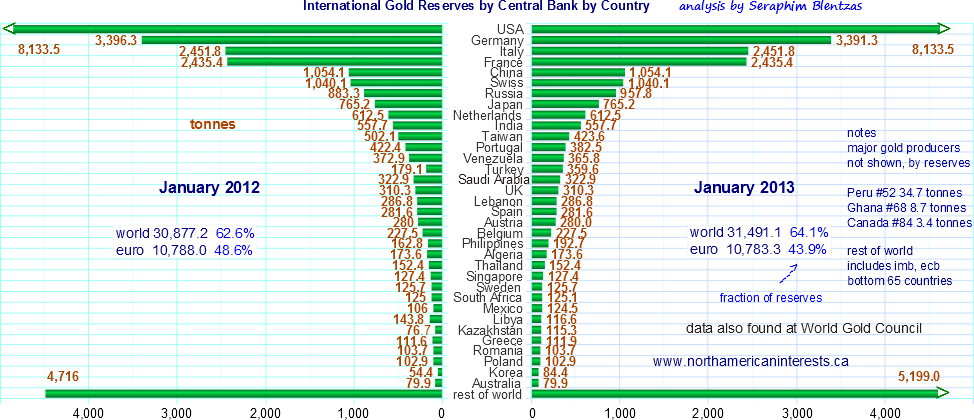
China Revises Gold Reserves (October 2015: China reserves)

- First time in four years China says anything about its reserves
- According to Wood Mackenzie China has 30,000 tonnes of gold, more than any other country.
Since the middle of the last decade China has been leading all countries in terms of gold output - very little of that actually leaves the country.. add to that the fact that China imports another 1000 tonnes of the yellow metal through various ports (HK being the largest) and you can start to see the potential it has to accumulate massive reserves.

  • Gold withdrawals from the Shanghai Gold Exchange hit a record high of 620 tonnes in the first three months of 2015. 
  • Private consumption in China is probably not that high meaning at least a portion of that is going to China's central bank.  Current estimates put China's reserves at just over 1000 tonnes, far behind the top four countries which have a combined 16,500 tonnes.

  • According to various sources out of China, the upcoming report will act to bolster China's currency - This gives foreign currency traders (and governments) more confidence in the yuan-renminbi as an alternative to the US dollar.

  • China and Brazil have already signed a $30 billion currency swap agreement.

Wednesday, August 31, 2011

AuRico Gold Intermediate Producer after wise acquisitions (Northgate Minerals, production, silver, 2012, exploration)

   Update for 4Q 2011 As reported on January 13, 2012 Aurico produced 72,119 ounces of pure gold (up from 29,384 in 2010) and 1.109 million ounces of silver (down from 1.2 million qoq), or 92,815 oz of gold equivalent (up from 53,030 qoq) during the three months ended Dec 31, 2011. Consolidated cash costs for the quarter were 67.1% higher to $680/oz due mainly to non Mexican operations in Australia acquired through the Northgate takeover (only produced 29,858 oz in the 2011 year but at a cash cost of $863/oz). North American operations finished the year at a cash cost of $499/oz (over 80% of production is still only coming from Mexico, Canadian projects won't start producing until 2012 at the earliest). Over the 12 months Aurico produced 187,401 oz of gold (up 64.3% from 114,064 oz) and 4.728 million ounces of silver (down 4.6% from 4.954 million yoy). The largest producing mine, Ocampo saw higher cash costs in the last quarter owing to lower grades being mined, while El Cubo's higher costs (up to $1,046 on the year) were due to a major conversion in its method of mining which may be part of the deal struck with workers in 2011 to raise standards at the mine, ending the shutdown. Ocampo still had relatively low production costs during the year ($413/oz in the 1st half, $436/oz in the third quarter). For the year Ocampo, which accounted for 72% of gold equivalent production had a cash cost of $415/oz (realized), down 5.0% (though it was $553/oz in the last quarter which could be an aberration considering Ocampo's cash costs have been inconsistent quarter to quarter throughout 2011 due to higher/lower grades being mined).

Stawell, AUS mine life ends in the second quarter of 2012 which you probably already realized considering 2011 4Q production between it and Fosterville was only 29,858 oz at a cash cost of $858/oz (2009 production there was 206,500 ounces, cash cost under $500/oz). Young-Davidson mine in Canada is 79% complete. Young Davidson will produce 180,000 ounces of gold a year for 15 years at a long term cash cost of $400/oz. El Cubo which was shutdown in 2010 had cash costs of $1,090 in the 4Q and $1,046 during the year BUT you have to remember that almost all of what El Cubo produces is silver (556,379 ounces in the quarter up 3.7% compared to only 8,670 ounces of gold).

Update for 3Q 2011 As reported by AuRico Gold on November 10, 2011 the company produced 45,686 gold ounces (up from 27,018) and 1.4 million silver ounces (up from 1.19m oz), or 76,630 oz of gold equivalent (up 68%) during the three months ended September 2011; All of the increases in production came from mines in Mexico meaning that the higher revenue and profit are not the result of the Northgate Minerals acquisition (Northgate's main properties are outside Mexico). Even though cash costs were up 9% to $487/oz margins were 55% higher ($1,217/oz) due to record breaking gold prices ($1,704/oz), that resulted in a 580% increase in profit (to $62.6M or 36c a share). The El Chanate mine became the first Mexican operation to record one million man hours of work without lost time injuries. Not all was rosy however, all of the production increases came from El Chanate and El Cubo two mines that produced neither gold nor silver in 2010, in 2011 they combined to produce 20,842 oz of gold (16,444 from El Chanate) and 308,528 oz of silver (all at El Cubo) while the company's main mine Ocampo showed negative production growth (-8% for gold production/-15.3% for gold sold and -10.5% for silver production/-20.4% for silver sold). Cash costs remained low at Ocampo ($436/oz) and high at El Cubo ($936/oz but down from 1,386/oz). Average realized gold price was $1,704/oz up 38.54% (from $1,230/oz), realized silver price was $38.13/oz nearly double what is was the year before ($19.19/oz). Higher production particularly from the smallest mine, El Cubo (gold equivalent ounces up to 11,360 oz from nil) propelled 2011 annual guidance up to a high of 195,000 oz from 189,000 oz. Range for silver is 4.95-5.0m ounces (up from 4.84-5.56). Cash costs for the year are on track to be $445-$475/oz. By comparison, in the first half of 2011 cash costs were $486/oz (even with Ocampo being $413/oz which is $23/oz lower than what it was in the 3Q).

   AuRico acquired Northgate Minerals on August 29, 2011 for US$1.49 billion which represents a whopping 46% premium to Northgate's average stock price in the previous 20 days, but a record low of 14.7 times EBITDA based on Northgate's earnings before tax, depreciation, ammortization in the previous 12 months, the lowest in a North American deal since 2004 when Goldcorp bought Wheaton (by comparison, Kinross Gold paid about 40 times more than EBITDA for Redback Mining). Ironically, Goldcorp is also the company that paid one of the highest premiums in a takeover, 56% higher than the average stock price for Andean
Resources in the 20 days leading up to the deal. (Bloomberg: Northgate Takeover Proving Cheapest) At a time when the price of gold is on the rise AuRico is being bold, making deals that most companies wouldn't think possible (AuRico made US$1.9 billion in takeovers since April 2011, that's 87% greater than AuRico's market value in 2010). (MorningstarAdvisers: Digging for Outliers in Gold Mining) Included in the deal is the $370 million Young-Davidson Mine in Ontario which could begin producing as early as late 2012 (3 million ounces/15 year mine life, Young-Davidson also has 1.5 billion pounds of copper). Also of note, Northgate's assets are scheduled to produce 75% more in 2013 than in 2011 compared to 40% for AuRico. AuRico also gains a foothold outside of Mexico for the first time. Ocampo, the company's biggest producing mine also produces silver at a rate of between 4 and 5 million ounces, annually. The two biggest operating mines, Ocampo and El Cubo each have their own ore processing mills with a capacity in excess of five thousand tonnes per day (combined). In the last quarter ended June 2011 the company's operating cash flow increased 247% and its 2011 pure gold production guidance increased to between 175 and 195,000 ounces, gold equivalent (includes silver) rising to 265-295,000 ounces (about 33% of total production comes from silver). (2011 2nd qtr report)

For AuRico, production costs are low (for the six months ended June 2011 it was $413/oz (2.4% lower) at its largest mine Ocampo which produces at a rate of just over 110,000 ounces annually, overall it was around $486/oz). Total production (after takeover of Northgate Minerals is complete) is comparable to Eldorado Gold, New Gold and Osisko mining, three companies that have a market value 2 to 3 times higher. Even after 2 deals in 5 months that boosted its size by more than 70% AuRico continues to be totally unhedged meaning that it is fully exposed to changes in the price of gold, not a bad position to be in at a time when gold investment is spiking (even debt laden nations like Greece are buying up the commodity, others like Thailand, Mexico, Russia, South Korea are increasing reserves).

The only downside of the deal is that it led to the break up of Northgate's takeover attempt of Primero Mining which would have given it another 3 million ounces of proven gold reserves at San Dimas, Mexico.

Saturday, August 13, 2011

Big Exploration Companies Only An Investment Away From Becoming Major Industry Players

&nbsp&nbsp It seems weird when a company with more resources of a particular commodity isn't valued higher by the stock market (compare, for example Seabridge Gold or Northgate Minerals to Detour Gold; Cenovus Energy (oil) to Anadarko Petroleum). When companies aren't producing (such as the case with many big exploration companies) people are more skeptical of their estimates, especially if they don't have the financing in place to turn projects into operations; Ivanhoe Mines suffered from that for years before Rio Tinto confirmed the company's standing by calling Oyu Tolgoi 'the biggest copper resource in the world'. Examples of companies that have gotten away with lieing about resources include Greywolf Resources, a group of companies in Argentina which the president claimed in 2004, lied about reserves, even Shell has been caught but that was at a time when regulations industry-wide, were softer. Furthermore, energy consumption experienced the biggest yearly increase since 1973 in 2010, in 2010 it was up 5.6% largely due to China (up 11.2% surpassing the USA) and non-OECD nations (63% higher than 2000 levels). (World energy consumption up 5.6% in 2010, biggest rise since 1973: BP) Brazil, for example was on pace to import 50% more gasoline in 2011 than in 2010 (3.2M barrels Jan-Aug compared to 3.2M barrels Jan-Dec accounting for 5% of domestic fuel needs). In 2010 90% of cars sold in Brazil run on a combination of bio-fuel and gasoline but bio-fuel is getting more expensive: Sugar cane price is up 85% over the last year. (Brazil boom takes world fuel markets by surprise)


Here are three companies that I think would benefit from more investment and media exposure.

Meg Energy - Recoverable oil resource is close to 6 billion barrels. That's almost as much as Canada's biggest petroleum companies Suncor (7-8 billion, with a market value of over US$50 billion), and Canadian Natural Resources (over 6 billion, MV is over US$40 billion). Being heavy oil doesn't really make a difference anymore as synthetic oil is easier to produce and more widely used than it used to be (though oil prices need to be at least $50/bbl for it to be economically viable to produce but I don't think that level will be breached anytime soon). Phase 2B of the Christina Lake project has costs totaling $1.4 billion (about the same as MEG's total cash and cash equivalents) that will be spent in 2011. The biggest phase of the project (will increase production by 250,000 barrels per day or 7X more than what phase 2B will produce) is the third phase. You can imagine the price tag there, receiving regulatory approval shouldn't be a problem but more investment will probably be needed. The company recently reached $10 billion in market value and China's third biggest oil company has already invested in it so attracting more shouldn't be difficult, but when it's announced, individual investors could show a lot more interest. Update: In October 2011 JP Morgan, the world's #1 bank in terms of revenue, forecast oil at $121/barrel by 2013, at the same time it expects oil prodction that year to rise by about 2M bbls/d to 91 million barrels a day.
By 2045 oil sands will produce close to 11M bbls/d and that will continue for a century. Between 2012 and 2020 oil output from the tar sands will double (1.7 mbpd --> 3.4 mbpd) and triple in the next 25 years to 5.1 million barrels per day. Tar sands crude is over five times more expensive to extract than middle east oil however with oil prices up more than 400% since 2001 and Alberta continuing to charge one of the lowest royalty rates in the world (fell from $3 to $2/bbl between 2001 and 2009) there is much profit to be made.

Bankers Petroleum - Has interest in Europe's largest onshore oil field (7.5 billion barrels in place). 2P reserves are over 268 million barrels and rising fast (proved reserves up 30% in 2010), including stakes held