Showing posts with label greek debt. Show all posts

Saturday, January 31, 2015

Reasons to Buy Gold and Silver in 2015: US Dollar, Currency Wars, Russian Reserves, Central Bank QE

Gold and Silver Market Ripe For Rapid Growth

Though stateside gold prices may appear docile, from a foreigner's perspective precious metal prices are already too high because in much of the rest of the world the key precious metals have become a lot more expensive to purchase thanks to currency wars : the mighty US dollar.

Seventy-five percent of silver production (mine production) happens at gold mines - this means that, when gold production slows down (companies shuttering mines which started happening in the middle of last year) silver output declines.  This keeps the gold silver ratio intact despite the delinking of the two metals at London's commodities bourse.

The core price is set by comex, the commodities exchange in NYC and thus is traded in USD.
The fact that the price of both pcm's has barely increased over the past six months in my opinion makes both ripe for the picking ! 
Elsewhere the strong US dollar is making gold increasingly harder to afford, but that's inflation spurred by changes in local currency rates;  though quantitative easing and changes in interest rates are wreaking havoc on other currencies, the USD already has that factored into its value.. with The Fed at its side nothing aside from a shaking of the Fed's basic policy of money creation can shake its value... or of course a tiring by currency traders of the endless excuses for more QE.

In my opinion however, gold should've gained much more than nothing in US dollar terms.  Demand is still rising especially among those seeking a tangible hedge against inflation, as well as by those transferring money out of equities in response to growing global economic uncertainty, a shrinking middle class. 


The Gold Supply Problem


reasons to buy gold, investing in gold bullion, silver bullion, gold price, silver price, fx rates, foreign currencies, wars, rumors, russia central bank, russia gold, russia, china gold currency, china gold imports, festivals, india gold, switzerland, gold exports, us dollar, dollar index, deliveries, swiss gold, switzerland exports, swiss franc,
Now there's also the inevitable gold supply problem : let's face it, prices crashed last year - and the big producers responded by shuttering mines, big mines that weren't producing at reasonable cash costs.  Restarting those mines doesn't happen overnight - it can take years to complete new shaft reconstruction, bring in the necessary capital investment funding, and in some cases may even involve reapplying for licenses and approvals.  The big gold companies are now worth a lot less making it increasingly difficult for them to get banks to lend them the billions of dollars needed to make the mines work.  Then of course there's the shareholders who need to be convinced that the metal prices won't collapse again.

As of 2014 there is an estimated 24 billion ounces of silver existing in the form of jewelry.  Total historic production of silver is about 52 billion ounces, eighty percent of that mined since the dawn of the twentieth century.  However, much of the 52b oz will never be available to the bullion market due to its historical value (in the form of religious items, museum pieces, non-scrap jewelry).

India Imports Record Amount Of Gold From Switzerland

According to data from November 2014 Indian imports of gold from Switzerland totaled CHF2.9 billion up a whopping 600% versus the previous year; it's not just that month either, in October it was up 280%; January through November gold imports amounted to 457 kilos.

Russia Continues To Add To Gold Reserves
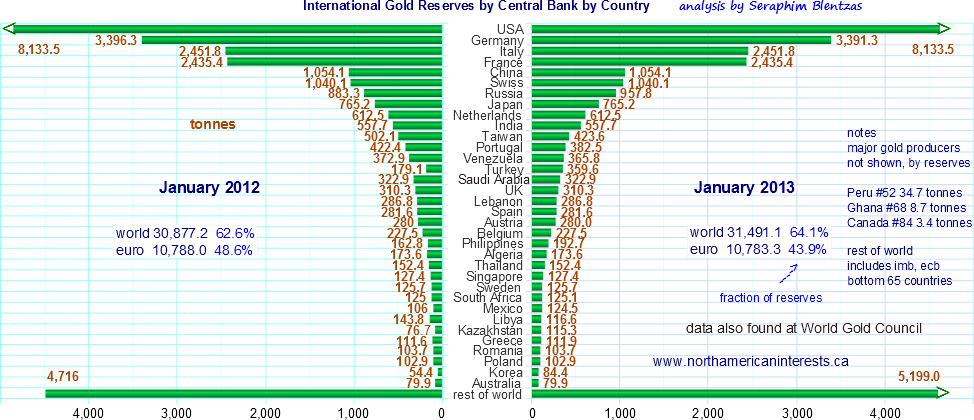
Russia purchased 20.73 tonnes of bullion in December - note also that in December gold prices were up for the first time in five months (+1%).  Makes Russian reserves fifth largest at 1210 tonnes.
Also notable - Ukraine held onto its reserves after selling 16 of 40 tonnes in Oct/Nov. 

Then there's the other central banks who cumulatively only became net buyers of gold since 2010 after 20 years of being net sellers.

Russia is key here - July through September 2014 it accounted for 59% of the 92.8t of net gold purchases by central banks.  Gold comprises just under 11% of Russian reserves up from 8% in 2013.  Those purchases allowed it to leapfrog China (1150 vs 1054).
Gold imports from HK by China were down last year but it was still the second highest on record at 813 tonnes.  Demand for gold should continue to increase into February as a result of Chinese new year festivities.

Don't Bet Against The Canadian Dollar !

I don't consider the current CDN/USD fxrate to be sustainable -  Beginning in 2016 oil prices are forecast to go up possibly by as much as 50% ($45->$65 per barrel).  Also note that Canada's federal government is starting to run a balanced budget while the USA has a severe, structural deficit which ultimately will lead the United States into a situation where it will be forced to run up high payments to foreign bondholders further weakening its long term outlook.

Don't Let Yesterday's Gold Selloff Turn You Off

- gold responds positively to durable goods numbers
- most global currencies are either under pressure (canada, australia, euro) or being deflated (asia) - this strengthens the US dollar in the near term but makes it increasingly vulnerable over the long term
- when the dollar shows any sign of weakness expect a big jump in precious metal prices
- Greek debt bailout 80 out of 240 billion is owed to Germany - If Greece doesn't pay up Germany will undoubtedly rethink its financial obligations to the Eurozone and that weakens Europe, its central bank and its structure.

Thursday, October 27, 2011

Euro zone leaders reach debt deal; Gold, Silver demand up/price up $100/oz on week

   In Brussels, European leaders alongside the IMF negotiated with the financial institutions that own Greek debt in the form of bonds. They struck a number of key agreements the main one being a reduction in the value of Greek bond debt by half (banks take on the 50% loss on the nominal value of those bonds) wiping out $100B worth of debt commitments, bringing debt to a more managable level (120% of GDP down from 160%). Some of the insurers affected such as France's Groupama (wrote 2 billion euro worth of CDS) could bear an even greater burden due to their issuance of credit default swaps (CDS contracts) which they'd have to honour if it's determined that a credit event has taken place (unlikely though given that the deal was not forced on either party). CDS contracts on Greek debt stand at $75 billion up 50% since 2009. To woo insurance companies, the EU made available to it a €30B+ credit. Also helping Greece; Government crackdown on corruption which could increase tax revenue by as much as €1.2B in 2011 (will force more businesses to collect taxes on sales).

Just because Greece was taken care of doesn't mean the European situtation has stabilized; Italian bond rates are currently at 6.5% (November 2011, was 5.867% on Oct 27) up from 4.6% in June 2011 meaning that Italy needs to raise €600 billion from private investors over the next three years just to finance its current debt level. In comparison, it was when the ten year Greek bond yield initially hit 8% that Greek debt became unmanageable. To deal with that problem the European Financial Stability Facility (EFSF) increased its available funds from €440 billion to €1.0 trillion euros (US$1.4 trillion) giving more security to Spain and Italy at least for the next couple years. Problems at the negotiating table remain an issue due to differences between Germany and France. News of the deal pushed the euro to a 7 week high against the US dollar ($1.42). Update: On November 3rd the yield on Greece's 2 year bond topped 100% for the first time.
2010 deficit to gdp ratio by country: UK: 10.4% (government debt is 80% of gdp), Spain 9.2% (Spain's unemployment rate suprassed 20% in 2010, total government debt to gdp ratio is 60%), France 7% (gov debt 81% of gdp), Italy 4.6% (gov debt 119% of gdp, austerity has included cutting back on public holidays). (CBC: TSX, loonie, soar on Europe crisis plan) The budget deficits in most of those countries is a direct result of deflation due to prices being too high/governments of the weak economies having no control over the currency (monetary policy). Also during the week, the EU approved another €130B bailout package.
Here is where Greece is coming from, Last year they had 800,000 civil servents collecting $48,000 annually in full pensions, those pensioners became eligible for that at age 52. New austerity measures are likey to impact those people significantly. European banks typically leverage about 80 times (debt used to acquire additional assets), that puts the EU in a more preciarious situation than the United States (40 times leverage). More info Buyers of Greek Bonds Choose only 1 of 4

Update - A new problem has since been acknowledged: The European Stability Fund is having a difficult time attracting investors. Canada has already said no to investment while China has "no concrete plans". The Fund recently delayed a €3B bond sale citing market conditions.

Gold is up again! Gold soared by 1.4% to $1,747.70 (after reaching a one month high of $1,728.11/oz, up half a percent before the day even began) as demand remains strong in China (high inflation, economic uncertainty, real estate bubble) and the rest of the world where many still view the EU's most recent deal as only a temporary fix that doesn't solve the root of the problem. SPDR Gold Shares added 16.645 tonnes over the last three sessions. Silver was up 5.77% or $1.80. There's also a temporary slowdown in demand from India (Diwali festival of lights festivities are ongoing; Diwali is a five day festival however the entire event including other festivities runs from the middle of October to the middle of November, most of its gold demand came in preparation for the festival) and Thailand (recovering from the worst floods in fifty years). In India, gold trades on the Multi Commodity Exchange (MCX) where the price is commonly listed per 10 grams. Indian gold demand was up 38% in the second quarter of 2011 and 29% in the last 12 months. Just to give you an idea of how unprecedented the price of gold is today; Over history, the last bull market high was $850/oz.


If, as many suggest, the People's Republic of China lets the RMB increase in value relative to the USD, that will weaken demand for gold in the short term as investors see the new exchange rate as a sign of economic stability but in the long run, the stronger RMB will increase Chinese demand for Gold due to its greater purchasing power. Also, a stronger RMB will raise Chinese import demand, indirectly increasing Gold demand from abroad too.
Platinum group metals increase Platinum was up 2.77% ($44.2/oz) by the end of the trading day Thursday to $1,641.4/oz. Platinum, used in everything from surgical equipment to white gold plating to catalytic converters, is produced at a rate of only 5-6M ounces a year (5-10% as much as gold). South Africa produces 80% of the world's platinum. Spot palladium up 2.78% to $665/oz reaching another one month high (also recorded one month high the day before). Palladium began the year around $799.5/oz but since then has dropped 20%, platinum began the year at around $1770/oz but has dropped 7.8% since.

Other Notes: In the July-September 2011 period the US economy grew 2.5% up from the 2.3% estimate.
Total EU-Canada (ex UK) trade is $50 billion (6% of total Canadian trade). News of the Greek debt deal boosted the exchange rates of a number of currencies against the American dollar however not versus the Chinese Yuan or Japan's Yen (Euro up 2% to US$1.42, Canadian dollar up 1.5 cents to above parity at US$101.02). Many non US currencies actually strengthened versus the euro and dollar (US & Cdn).
Sony buys out its partnership with Ericsson for $1.5B giving Sony complete control over its smartphone business, allowing it integrate more of its products and software. Ericsson will now be able to focus more on its wireless technologies. Total world debt represents about 5X total GNP.