Showing posts with label HSBC. Show all posts

Wednesday, October 30, 2013

Air Canada (AC.B) Profitable ? Revenue Up At Chinese Banks, Earnings Dividends At Citigroup, HSBC

Air Canada (AC.B) is making more revenue per passenger and that's one of the reasons investors continue to reward this airline stock with record growth (+52% last month, +150% last 3-months).  In fact just yesterday, the stock touched a five year high of $5.80 up from $1.80 exactly one year ago (Oct. 30).  The company has had success charging passengers additional fees for meals, pillows, earphones and other conveniences previously taken for granted.  Also giving the company lift is its own new discount carrier Air Canada Rouge launched in July 2013.
For the first time in a long time, earnings are showing signs of breaking into positive territory !  Quarterly net loss now at $(23) million, down considerably from $(160) million last year.  Passenger revenue is up (+$86m for 2q13, +$89m 1h13),  First half operating profit was $174m up 176% from last year's $63m.
Lower fuel costs (-$57m quarter, -$76m half) not the main reason quarterly operating expenses are down (1.4)% (total increase in salaries + currency effects were +$60m)  : this proves that the company is getting its act together ! 
Despite currency effects weighing on results [1h13 $(114m) vs +$26m] and wages/salaries up bigtime (+9% quarter, +7% half), overall operating expenses declined (-1.4% quarter, -0.6% half).  Also a positive sign: cash equivalents up 4.8% to $790m after declining (6.6)% in the second half of last year.  Long term debt was lowered by $315m (half) vs $238m last year. 
Airline Stock October 30 2013 1-year 3-months 1-month
Air Canada (AC.B) 209% 150% 52%
Westjet (WGA) 54% 34% 8%


Air Canada benefits from more international travel particularly to and from China;  The last two census results show Canada's Chinese population is up 141,070 or +10.5% in five years; in 2010 Canada acquired Approved Destination Status which is key since it was one of the last major countries not to have it.  At the time, it was estimated that by 2014 Chinese travel to Canada would increase 50%.  Direct competitor Westjet (WGA) has also been reaping the benefits of increased air travel within Canada and to and from the country.  First half revenue up +6.5% ($1,810.93 million), earnings up +22.6% ($135.8m).

Among The World's Largest Banks China's Phenomenal Revenue Growth;  Earnings Dividends At Citigroup, HSBC Remain Healthy

  • TD Bank reported 18% growth in average loans (3q2013). 
  • JPMorgan Chase - 3rd quarter earnings take a hit :  down -$380m due to - $9.15 billion pretax expense; $7.20 billion after-tax (eps down 185c) for legal expense in Corporate, including reserves for litigation and regulatory proceeding. - $1.60 billion pretax benefit; $992 million after-tax (eps up 26c) from lower reserves in Consumer & Community. 
  • China Construction Bank - lending fee incomes climbed contributing to increased revenue.  earnings increases lagged analyst expectations of CNY57.69 billion.


Canadian Retailer Hudson's Bay Becomes Major Player In North America's Fashion Retail Industry

Just yesterday HBC's $2.9 billion takeover deal for Saks Inc received Saks shareholder approval.  The Toronto-based company will operate 320 stores in prime retail locations throughout North America.  After the merger, Hudson's Bay Company will have annual sales in excess of $7 billion.  Investors take note:  HBC growth plans for the company are synonymous with increasing shareholder value. 

Monday, March 19, 2012

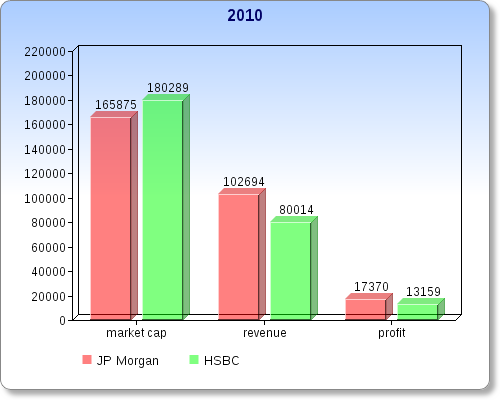
HSBC and JP Morgan record strong results in 2011 but stock market valuation still waning

Interesting Facts

- The China-Brazil trade corridoor had a compound annual growth rate of 30% during the last decade.
- China accounts for 18% of Brazil's total trade, up from 4% in 2000.
- HSBC has only been in Brazil since 1997 but it is already a significant contributor to the country's economy. HSBC now finances 6% of the Latin American country's foreign trade.
- Using current dollars, median household income in British Columbia, Canada is $68,000 today, down from $72,000 in 1971. (source: CBC) What's alarming about that is the fact that the average home price was only $272,000 which is a lot lower than today's $806,000.
- On November 29, 2011 JP Morgan sold 198.143 million shares of HSBC Holdings stock (1.11% interest in the company) for HK$58.83 a share.  That reduced JP Morgan's interest in HSBC to 6.35% down from 7.46%


JP Morgan

       In 2011, the bank ranked first in terms of global investment banking fees. Though profit was down -22.9% over the last quarter of 2011, total annual profit for the year reached a record high of $19 billion +9.2% vs 2010;  Net income per share improved even more, +13.1% to $4.48. During the fourth quarter, non-performing assets fell -33%.  Also in the fourth, the bank repurchased $950 million worth of common stock, bringing the total repurchased on the year to $2.9 billion.  It's important to remember that, even though JP Morgan has the highest market cap among the top banks (outside China) it remains smaller than Bank of America in terms of employees (260,000 vs 300,000) and revenue ($97.234b vs $115.0b).

What tells me the bank's business is a lot healthier today than last year is the charge-off's vs credit loans;  Credit sales volume +10% on the year while consequently net-charge off's happened at the lower rate of 3.93% (down from 4.34%).  Deposits are now at $1.1 trillion, +21%.  JPMorgan's Investment Bank's provision for credit card losses was up to $272 million at the end of last quarter which compares nicely to the loss of $271 million last year and +54 million in the previous quarter (3Q2011).  However it must be noted that, the increased provisions for credit card losses on the year caused net income for the investment bank division to fall by 52% to $726 million.

The commercial banking unit experienced a 21% increase in profit (to $643 million) on record net revenue. Net charge offs down from $286 million to $99 million.

HSBC

Market capitalization down significantly to $136 billion from $180 billion (end 2010) and $199 billion (end 2009).  In fact, by the end of the the 2011 calendar year, Wells Fargo pulled ahead of HSBC in terms of market cap (Wells Fargo finished 26 overall, in front of HSBC at 28).  Since the financial crisis of 2006-2007, over the last four years HSBC paid out more dividends than any other FTSE100 listed bank except one (US$27.2 billion/ $7.3b in 2011 alone).  Dividends were up +14% in 2011. HSBC's costs +10% in 2011 due to, among other things, wage inflation (a new bank fee charged to it by the UK government in the amount of $570m.  Underlying costs now account for 61% of revenue up from 55% in 2010). North American operations accounted for only 0.5% ($100m) of HSBC's profit before tax (compared to 2.4% = $454m in 2010).

North American business has become a bit more risky as it now accounts for 22.8% of the company's risk-weighted assets ($337.3m, up from $330.7m in 2010) even though the region represents only 19.7% of total assets ($504m out of $2555.6m). Many of the bank's key financial metrics were up on the year, however there were a couple that weren't; Down were: Underlying profit before taxation: -6% to $17.696 billion, total loans and advancements -2% to $940 million. Good decreases: Ratio of loan impairment chargest to total operating income down to 13.8% from 16.9% in 2010 and 31.7% in 2009.

Thursday, August 25, 2011

Industrial and Commercial Bank of China (ICBC), the World's Largest Bank Is Bigger Than You Think

&nbsp&nbsp&nbsp&nbsp&nbsp Since July 24, 2007 when it overtook CitiBank in market capitalization (US$ 254 billion versus US$ 251 billion) ICBC has been the largest bank in the world by market value (4th overall. It is 22.7% bigger than domestic competitor China Construction Bank, in contrast, construction bank's (2nd largest bank by market cap) overall rank fell 5 spots to 12 down from 7 in March). (FT Global 500 List June 2011) ICBC's impressive performance during the economic crisis has lifted it higher in The Global 2000, a ranking system compiled by Forbes; in it ICBC was ranked 12 overall in 2009, 5 in 2010 and 7 in 2011 (2011 slight drop was because higher oil prices pushed 3 oil companies into the top 6, by comparison none were top 6 in 2010), in 2011 ICBC overtook Bank of America but was overtaken by JP Morgan (rank 1st overall on highest sales of any bank and strong earnings) and HSBC (rank 2nd on high sales and assets (4)); HSBC was ranked lower than ICBC in 2010 (8 versus 5) but in 2011 it shot up to 2 (ICBC 7), JP Morgan was ranked higher than ICBC both years even though its market value was much lower and ICBC had 41% more profit (US$24B vs US$17B). In March of 2009 ICBC became the world's biggest bank in terms of deposits after its clients added US$140 billion to accounts bringing the total to US$1.31 trillion, higher than JP Morgan and Mitsubishi UFJ Financial Group.

Although many key indicators for ICBC improved in 2010 [(cost/income ratio down to near record low levels (30.99%) at a time when wealth managers worldwide are facing higher cost/income ratio's (wealthbriefing.com): Net fee, commission/operating income ratio 19.13 a 4 year high, 4 year high also in ROA assets (1.32% up 86% since 2006), ROA equity (22.79% up 336 basis points in 2 years), non-performing loans ratio down to 1.08 (down 49% since 2008)], the bank's market value has been slow to respond (growth) because of concerns among investors regarding banking risks faced industry-wide (brought on by banks abroad in countries where unemployment is high and consumer debt, national exceeds annual income, gdp) and a possible housing bubble in mainland China (loans secured by mortgages amounted to US$ 421.117 billion on December 31, 2010 up 31.2% since December 31, 2009 (US$ 321.063)); Market Values in the graph for the 3 big banks are from December 31 for each year, the end of the fiscal period.

In terms of revenue, JP Morgan still leads all banks however the major Chinese banks including ICBC significantly closed the gap between themselves and Bank of America/Citigroup. In the first half of 2011 HSBC leaprogged all banks except JPM even though its revenue grew by only 5%. Chinese institutions closed the revenue gap with their Western counterparts, ICBC only 45% the revenue of Bank of America (56% of Citigroup) in 2010 1st half but that increased to 88% in 2011. More info on 2011 revenue, assets at top 20 banks as of September 2011 ranked by 2011 2nd half metrics

Mortgage loans make up 41% of all loans at ICBC (2011 January 1) up from 38.3% a year earlier even though the government instituted new laws aimed at limiting lending to local governments (financing vehicles) and to the real estate sector. In May of 2011 in an attempt to reduce mortgage risks, ICBC told separate branches to raise certain minimum downpayments (up to 40% from 30% in places where prices are unusually high) and lending rates when the branch sees fit (110% higher than the benchmark best), in 2010 home prices were up 47% in Hangzhou (Zhejian ranks 5 in gdp per capita (US$7.4th), 10 in population), 37.9% in Chongqing (14 gdp pc (US$4th)/20 in pop.) and 37.1% in Beijing (3 in gdp pc (10.4th/26 in pop.). Prior to the increase, buyers of a second home were required to give a 60% down payment. (BBC: ICBC bank's profits surge as China economy grows, China Economic Review)

Also, the bank's less than perfect credit rating (A1+) due to the bank being highly exposed to a softening Chinese real estate market and having increased international exposure (Chinese government has shown interest in helping the bank gain a foothold outside the mainland since Chinese banks don't have as much global exposure as their western counterparts and China has the capability to do that; China has shown interest in establishing new international finance; In 2009 it gave China Investment Corp $200 billion to do that), may have scared away some investors who aren't aware of the bank's solid fundamentals (arrears/risks are as low as any other bank even those with better Moody's ratings).

At a time when the largest bank based outside of China (HSBC, US$ 176.9 billion in market cap) announced a 3 year plan to cut 30,000 jobs worldwide (10% of its workforce, 20-25% of its employees in Europe and North America), China's ICBC is hiring (workforce is over 397,000 up 1.8% on the year with over