Interesting Facts
- The China-Brazil trade corridoor had a compound annual growth rate of 30% during the last decade.
- China accounts for 18% of Brazil's total trade, up from 4% in 2000.
- HSBC has only been in Brazil since 1997 but it is already a significant contributor to the country's economy. HSBC now finances 6% of the Latin American country's foreign trade.
- Using current dollars, median household income in British Columbia, Canada is $68,000 today, down from $72,000 in 1971. (source: CBC) What's alarming about that is the fact that the average home price was only $272,000 which is a lot lower than today's $806,000.
- On November 29, 2011 JP Morgan sold 198.143 million shares of HSBC Holdings stock (1.11% interest in the company) for HK$58.83 a share. That reduced JP Morgan's interest in HSBC to 6.35% down from 7.46%
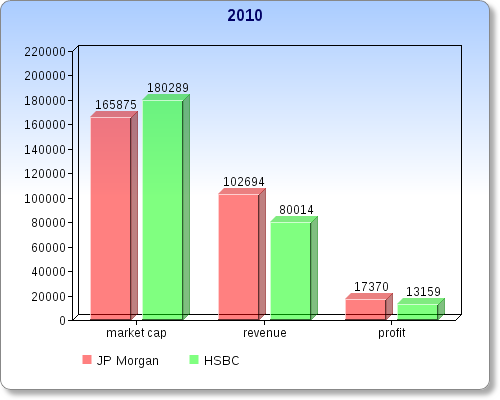
In 2011, the bank ranked first in terms of global investment banking fees. Though profit was down -22.9% over the last quarter of 2011, total annual profit for the year reached a record high of $19 billion +9.2% vs 2010; Net income per share improved even more, +13.1% to $4.48. During the fourth quarter, non-performing assets fell -33%. Also in the fourth, the bank repurchased $950 million worth of common stock, bringing the total repurchased on the year to $2.9 billion. It's important to remember that, even though JP Morgan has the highest market cap among the top banks (outside China) it remains smaller than Bank of America in terms of employees (260,000 vs 300,000) and revenue ($97.234b vs $115.0b).
What tells me the bank's business is a lot healthier today than last year is the charge-off's vs credit loans; Credit sales volume +10% on the year while consequently net-charge off's happened at the lower rate of 3.93% (down from 4.34%). Deposits are now at $1.1 trillion, +21%. JPMorgan's Investment Bank's provision for credit card losses was up to $272 million at the end of last quarter which compares nicely to the loss of $271 million last year and +54 million in the previous quarter (3Q2011). However it must be noted that, the increased provisions for credit card losses on the year caused net income for the investment bank division to fall by 52% to $726 million.
The commercial banking unit experienced a 21% increase in profit (to $643 million) on record net revenue. Net charge offs down from $286 million to $99 million.
HSBC
Market capitalization down significantly to $136 billion from $180 billion (end 2010) and $199 billion (end 2009). In fact, by the end of the the 2011 calendar year, Wells Fargo pulled ahead of HSBC in terms of market cap (Wells Fargo finished 26 overall, in front of HSBC at 28). Since the financial crisis of 2006-2007, over the last four years HSBC paid out more dividends than any other FTSE100 listed bank except one (US$27.2 billion/ $7.3b in 2011 alone). Dividends were up +14% in 2011. HSBC's costs +10% in 2011 due to, among other things, wage inflation (a new bank fee charged to it by the UK government in the amount of $570m. Underlying costs now account for 61% of revenue up from 55% in 2010). North American operations accounted for only 0.5% ($100m) of HSBC's profit before tax (compared to 2.4% = $454m in 2010).
North American business has become a bit more risky as it now accounts for 22.8% of the company's risk-weighted assets ($337.3m, up from $330.7m in 2010) even though the region represents only 19.7% of total assets ($504m out of $2555.6m). Many of the bank's key financial metrics were up on the year, however there were a couple that weren't; Down were: Underlying profit before taxation: -6% to $17.696 billion, total loans and advancements -2% to $940 million. Good decreases: Ratio of loan impairment chargest to total operating income down to 13.8% from 16.9% in 2010 and 31.7% in 2009.
Showing posts with label financial institutions. Show all posts
Monday, March 19, 2012
HSBC and JP Morgan record strong results in 2011 but stock market valuation still waning
Labels:
2011,
2012,
banks,
financial institutions,
financial stocks,
global banking,
gold investing,
HSBC,
HSBC revenue,
jp morgan,
JP Morgan competition,
largest banks
Tuesday, January 3, 2012
European Bank Stocks Oversold?
When European-debt exposed Intesa Sanpaolo and Societe Generale begin showing any signs of growth you know they've reached rock bottom. As you can see in the months leading up to November 24, 2011 Europe's twelve largest financial institutions were in a free fall, granted Canadian and Australian banks were also losing value but not nearly as fast. In the month of December top European banks nearly matched their Canadian and Australian counterparts (I use Canadian and Australian banks as the reference because they performed ok during the economic crisis and are in an enviable position rating-wise, though some like the Royal Bank have risk exposure). The comparable growth in capitalization as measured in US dollars, over the six weeks leading to January 3 even takes into account exchange rate effects and the strong US dollar. Before jumping in however, take caution; On December 15, 2011 UBS, Credit Suisse, Barclays, BNP Paribas, and Societe Generale were all downgraded by Paris based ratings agency Fitch Ratings. Before deeming that too great a risk keep in mind that those banks are also on the g20's list of 29 too big to fail financial institutions (5 of the 8 banks downgraded are European) taking away some of the perceived risk. What does too big to fail mean exactly?
Financial institutions whose distress or disorderly failure, because of their size, complexity and systemic interconnectedness, would cause significant disruption to the wider financial system and economic activity. To avoid this outcome, authorities have all too frequently had no choice but to forestall the failure of such institutions through public solvency support. As underscored by this crisis, this has deleterious consequences for private incentives and for public finances.The g20 made the list in part to put pressure on the banks to increase their loan loss reserves. Have they done it yet? We'll find out in their 2011 annual reports which will be coming out over the next couple months. I'll report on that when they come out. European banks typically leverage about 80 times (debt used to acquire additional assets), that puts the EU in a more preciarious situation than the Canada or Australia (in the US leverage is typically 40 times).
Strength in the European market: Societe Generale gets 20% of its net banking income from less risky Russia.
For Credit Agricole cost of risk didn't increase between 2010 and the 3rd quarter of 2011.
Deutsche Bank profited 3.985 billion EUR in the first nine months of 2011. In stark contrast, it lost 612 million EUR in the second half of 2010. One thing to remember about Deutsche Bank though is that it waited until the quarter ended December 2010 to hand out a dividend of 75 cents per share. It could do the same again this year considering the company reported no losses in 2011 (pending last quarter).
Strength in the Canadian market: Canada’s top six banks currently offer a dividend yield of 4.69 per cent (average). The S&P/TSX Financial Services Index which closed at a 14-month low at the end of November, is 75% weighted in Canadian bank stocks. Canadian banks don't have much direct exposure to European debt but their stock performance seems to be tied to the situation in Europe.
BNP Paribas is by some measures the largest of the European banks (assets especially) but be warned, as of the 3Q of 2011 it had over 14 billion euro worth of soveign debt exposure in Italy (12) and Greece (2) alone. European Stability Fund bonds are not attracting as much investment as anticipated and that affects BNP's situation. If you want to invest in EU banks but want to take a less riskier approach, check to see if they own any credit default swaps (CDS): contracts made with insurance companies who have agreed to take on losses incured by the institution in the even of a credit situation (country defaults and the bank is left holding worthless bonds).
Labels:
banco santander,
Big five banks,
bnp paribas,
credit default swaps,
EU Banks,
European banks,
financial institutions,
largest Australian banks,
largest Canadian banks,
royal bank,
westpac banking
Subscribe to:
Posts (Atom)


