Interesting Facts
- The China-Brazil trade corridoor had a compound annual growth rate of 30% during the last decade.
- China accounts for 18% of Brazil's total trade, up from 4% in 2000.
- HSBC has only been in Brazil since 1997 but it is already a significant contributor to the country's economy. HSBC now finances 6% of the Latin American country's foreign trade.
- Using current dollars, median household income in British Columbia, Canada is $68,000 today, down from $72,000 in 1971. (source: CBC) What's alarming about that is the fact that the average home price was only $272,000 which is a lot lower than today's $806,000.
- On November 29, 2011 JP Morgan sold 198.143 million shares of HSBC Holdings stock (1.11% interest in the company) for HK$58.83 a share. That reduced JP Morgan's interest in HSBC to 6.35% down from 7.46%
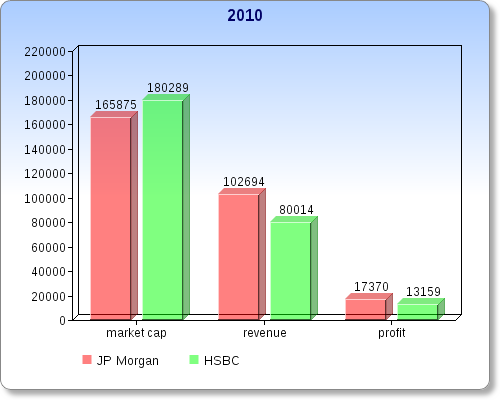
In 2011, the bank ranked first in terms of global investment banking fees. Though profit was down -22.9% over the last quarter of 2011, total annual profit for the year reached a record high of $19 billion +9.2% vs 2010; Net income per share improved even more, +13.1% to $4.48. During the fourth quarter, non-performing assets fell -33%. Also in the fourth, the bank repurchased $950 million worth of common stock, bringing the total repurchased on the year to $2.9 billion. It's important to remember that, even though JP Morgan has the highest market cap among the top banks (outside China) it remains smaller than Bank of America in terms of employees (260,000 vs 300,000) and revenue ($97.234b vs $115.0b).
What tells me the bank's business is a lot healthier today than last year is the charge-off's vs credit loans; Credit sales volume +10% on the year while consequently net-charge off's happened at the lower rate of 3.93% (down from 4.34%). Deposits are now at $1.1 trillion, +21%. JPMorgan's Investment Bank's provision for credit card losses was up to $272 million at the end of last quarter which compares nicely to the loss of $271 million last year and +54 million in the previous quarter (3Q2011). However it must be noted that, the increased provisions for credit card losses on the year caused net income for the investment bank division to fall by 52% to $726 million.
The commercial banking unit experienced a 21% increase in profit (to $643 million) on record net revenue. Net charge offs down from $286 million to $99 million.
HSBC
Market capitalization down significantly to $136 billion from $180 billion (end 2010) and $199 billion (end 2009). In fact, by the end of the the 2011 calendar year, Wells Fargo pulled ahead of HSBC in terms of market cap (Wells Fargo finished 26 overall, in front of HSBC at 28). Since the financial crisis of 2006-2007, over the last four years HSBC paid out more dividends than any other FTSE100 listed bank except one (US$27.2 billion/ $7.3b in 2011 alone). Dividends were up +14% in 2011. HSBC's costs +10% in 2011 due to, among other things, wage inflation (a new bank fee charged to it by the UK government in the amount of $570m. Underlying costs now account for 61% of revenue up from 55% in 2010). North American operations accounted for only 0.5% ($100m) of HSBC's profit before tax (compared to 2.4% = $454m in 2010).
North American business has become a bit more risky as it now accounts for 22.8% of the company's risk-weighted assets ($337.3m, up from $330.7m in 2010) even though the region represents only 19.7% of total assets ($504m out of $2555.6m). Many of the bank's key financial metrics were up on the year, however there were a couple that weren't; Down were: Underlying profit before taxation: -6% to $17.696 billion, total loans and advancements -2% to $940 million. Good decreases: Ratio of loan impairment chargest to total operating income down to 13.8% from 16.9% in 2010 and 31.7% in 2009.
Showing posts with label banks. Show all posts
Monday, March 19, 2012
HSBC and JP Morgan record strong results in 2011 but stock market valuation still waning
Labels:
2011,
2012,
banks,
financial institutions,
financial stocks,
global banking,
gold investing,
HSBC,
HSBC revenue,
jp morgan,
JP Morgan competition,
largest banks
Thursday, October 27, 2011
Euro zone leaders reach debt deal; Gold, Silver demand up/price up $100/oz on week
   In Brussels, European leaders alongside the IMF negotiated with the financial institutions that own Greek debt in the form of bonds. They struck a number of key agreements the main one being a reduction in the value of Greek bond debt by half (banks take on the 50% loss on the nominal value of those bonds) wiping out $100B worth of debt commitments, bringing debt to a more managable level (120% of GDP down from 160%). Some of the insurers affected such as France's Groupama (wrote 2 billion euro worth of CDS) could bear an even greater burden due to their issuance of credit default swaps (CDS contracts) which they'd have to honour if it's determined that a credit event has taken place (unlikely though given that the deal was not forced on either party). CDS contracts on Greek debt stand at $75 billion up 50% since 2009. To woo insurance companies, the EU made available to it a €30B+ credit. Also helping Greece; Government crackdown on corruption which could increase tax revenue by as much as €1.2B in 2011 (will force more businesses to collect taxes on sales).
Just because Greece was taken care of doesn't mean the European situtation has stabilized; Italian bond rates are currently at 6.5% (November 2011, was 5.867% on Oct 27) up from 4.6% in June 2011 meaning that Italy needs to raise €600 billion from private investors over the next three years just to finance its current debt level. In comparison, it was when the ten year Greek bond yield initially hit 8% that Greek debt became unmanageable. To deal with that problem the European Financial Stability Facility (EFSF) increased its available funds from €440 billion to €1.0 trillion euros (US$1.4 trillion) giving more security to Spain and Italy at least for the next couple years. Problems at the negotiating table remain an issue due to differences between Germany and France. News of the deal pushed the euro to a 7 week high against the US dollar ($1.42). Update: On November 3rd the yield on Greece's 2 year bond topped 100% for the first time.
2010 deficit to gdp ratio by country: UK: 10.4% (government debt is 80% of gdp), Spain 9.2% (Spain's unemployment rate suprassed 20% in 2010, total government debt to gdp ratio is 60%), France 7% (gov debt 81% of gdp), Italy 4.6% (gov debt 119% of gdp, austerity has included cutting back on public holidays). (CBC: TSX, loonie, soar on Europe crisis plan) The budget deficits in most of those countries is a direct result of deflation due to prices being too high/governments of the weak economies having no control over the currency (monetary policy). Also during the week, the EU approved another €130B bailout package.
Here is where Greece is coming from, Last year they had 800,000 civil servents collecting $48,000 annually in full pensions, those pensioners became eligible for that at age 52. New austerity measures are likey to impact those people significantly. European banks typically leverage about 80 times (debt used to acquire additional assets), that puts the EU in a more preciarious situation than the United States (40 times leverage). More info Buyers of Greek Bonds Choose only 1 of 4
Update - A new problem has since been acknowledged: The European Stability Fund is having a difficult time attracting investors. Canada has already said no to investment while China has "no concrete plans". The Fund recently delayed a €3B bond sale citing market conditions.
Gold is up again! Gold soared by 1.4% to $1,747.70 (after reaching a one month high of $1,728.11/oz, up half a percent before the day even began) as demand remains strong in China (high inflation, economic uncertainty, real estate bubble) and the rest of the world where many still view the EU's most recent deal as only a temporary fix that doesn't solve the root of the problem. SPDR Gold Shares added 16.645 tonnes over the last three sessions. Silver was up 5.77% or $1.80. There's also a temporary slowdown in demand from India (Diwali festival of lights festivities are ongoing; Diwali is a five day festival however the entire event including other festivities runs from the middle of October to the middle of November, most of its gold demand came in preparation for the festival) and Thailand (recovering from the worst floods in fifty years). In India, gold trades on the Multi Commodity Exchange (MCX) where the price is commonly listed per 10 grams. Indian gold demand was up 38% in the second quarter of 2011 and 29% in the last 12 months. Just to give you an idea of how unprecedented the price of gold is today; Over history, the last bull market high was $850/oz.
If, as many suggest, the People's Republic of China lets the RMB increase in value relative to the USD, that will weaken demand for gold in the short term as investors see the new exchange rate as a sign of economic stability but in the long run, the stronger RMB will increase Chinese demand for Gold due to its greater purchasing power. Also, a stronger RMB will raise Chinese import demand, indirectly increasing Gold demand from abroad too.
Platinum group metals increase Platinum was up 2.77% ($44.2/oz) by the end of the trading day Thursday to $1,641.4/oz. Platinum, used in everything from surgical equipment to white gold plating to catalytic converters, is produced at a rate of only 5-6M ounces a year (5-10% as much as gold). South Africa produces 80% of the world's platinum. Spot palladium up 2.78% to $665/oz reaching another one month high (also recorded one month high the day before). Palladium began the year around $799.5/oz but since then has dropped 20%, platinum began the year at around $1770/oz but has dropped 7.8% since.
Other Notes: In the July-September 2011 period the US economy grew 2.5% up from the 2.3% estimate.
Total EU-Canada (ex UK) trade is $50 billion (6% of total Canadian trade). News of the Greek debt deal boosted the exchange rates of a number of currencies against the American dollar however not versus the Chinese Yuan or Japan's Yen (Euro up 2% to US$1.42, Canadian dollar up 1.5 cents to above parity at US$101.02). Many non US currencies actually strengthened versus the euro and dollar (US & Cdn).
Sony buys out its partnership with Ericsson for $1.5B giving Sony complete control over its smartphone business, allowing it integrate more of its products and software. Ericsson will now be able to focus more on its wireless technologies. Total world debt represents about 5X total GNP.
Just because Greece was taken care of doesn't mean the European situtation has stabilized; Italian bond rates are currently at 6.5% (November 2011, was 5.867% on Oct 27) up from 4.6% in June 2011 meaning that Italy needs to raise €600 billion from private investors over the next three years just to finance its current debt level. In comparison, it was when the ten year Greek bond yield initially hit 8% that Greek debt became unmanageable. To deal with that problem the European Financial Stability Facility (EFSF) increased its available funds from €440 billion to €1.0 trillion euros (US$1.4 trillion) giving more security to Spain and Italy at least for the next couple years. Problems at the negotiating table remain an issue due to differences between Germany and France. News of the deal pushed the euro to a 7 week high against the US dollar ($1.42). Update: On November 3rd the yield on Greece's 2 year bond topped 100% for the first time.
2010 deficit to gdp ratio by country: UK: 10.4% (government debt is 80% of gdp), Spain 9.2% (Spain's unemployment rate suprassed 20% in 2010, total government debt to gdp ratio is 60%), France 7% (gov debt 81% of gdp), Italy 4.6% (gov debt 119% of gdp, austerity has included cutting back on public holidays). (CBC: TSX, loonie, soar on Europe crisis plan) The budget deficits in most of those countries is a direct result of deflation due to prices being too high/governments of the weak economies having no control over the currency (monetary policy). Also during the week, the EU approved another €130B bailout package.
Here is where Greece is coming from, Last year they had 800,000 civil servents collecting $48,000 annually in full pensions, those pensioners became eligible for that at age 52. New austerity measures are likey to impact those people significantly. European banks typically leverage about 80 times (debt used to acquire additional assets), that puts the EU in a more preciarious situation than the United States (40 times leverage). More info Buyers of Greek Bonds Choose only 1 of 4
Update - A new problem has since been acknowledged: The European Stability Fund is having a difficult time attracting investors. Canada has already said no to investment while China has "no concrete plans". The Fund recently delayed a €3B bond sale citing market conditions.
Gold is up again! Gold soared by 1.4% to $1,747.70 (after reaching a one month high of $1,728.11/oz, up half a percent before the day even began) as demand remains strong in China (high inflation, economic uncertainty, real estate bubble) and the rest of the world where many still view the EU's most recent deal as only a temporary fix that doesn't solve the root of the problem. SPDR Gold Shares added 16.645 tonnes over the last three sessions. Silver was up 5.77% or $1.80. There's also a temporary slowdown in demand from India (Diwali festival of lights festivities are ongoing; Diwali is a five day festival however the entire event including other festivities runs from the middle of October to the middle of November, most of its gold demand came in preparation for the festival) and Thailand (recovering from the worst floods in fifty years). In India, gold trades on the Multi Commodity Exchange (MCX) where the price is commonly listed per 10 grams. Indian gold demand was up 38% in the second quarter of 2011 and 29% in the last 12 months. Just to give you an idea of how unprecedented the price of gold is today; Over history, the last bull market high was $850/oz.
If, as many suggest, the People's Republic of China lets the RMB increase in value relative to the USD, that will weaken demand for gold in the short term as investors see the new exchange rate as a sign of economic stability but in the long run, the stronger RMB will increase Chinese demand for Gold due to its greater purchasing power. Also, a stronger RMB will raise Chinese import demand, indirectly increasing Gold demand from abroad too.
Platinum group metals increase Platinum was up 2.77% ($44.2/oz) by the end of the trading day Thursday to $1,641.4/oz. Platinum, used in everything from surgical equipment to white gold plating to catalytic converters, is produced at a rate of only 5-6M ounces a year (5-10% as much as gold). South Africa produces 80% of the world's platinum. Spot palladium up 2.78% to $665/oz reaching another one month high (also recorded one month high the day before). Palladium began the year around $799.5/oz but since then has dropped 20%, platinum began the year at around $1770/oz but has dropped 7.8% since.
Other Notes: In the July-September 2011 period the US economy grew 2.5% up from the 2.3% estimate.
Total EU-Canada (ex UK) trade is $50 billion (6% of total Canadian trade). News of the Greek debt deal boosted the exchange rates of a number of currencies against the American dollar however not versus the Chinese Yuan or Japan's Yen (Euro up 2% to US$1.42, Canadian dollar up 1.5 cents to above parity at US$101.02). Many non US currencies actually strengthened versus the euro and dollar (US & Cdn).
Sony buys out its partnership with Ericsson for $1.5B giving Sony complete control over its smartphone business, allowing it integrate more of its products and software. Ericsson will now be able to focus more on its wireless technologies. Total world debt represents about 5X total GNP.
Labels:
banks,
China,
credit default swaps,
euro,
euro zone debt crisis,
gdp,
gold demand,
gold price,
Greece,
greek debt,
groupama,
IMF,
India,
investing in gold,
Italy,
platinum,
Spain,
SPDR gold shares,
Thailand,
US dollar
Subscribe to:
Posts (Atom)


