Saturday, January 31, 2015

Reasons to Buy Gold and Silver in 2015: US Dollar, Currency Wars, Russian Reserves, Central Bank QE

Gold and Silver Market Ripe For Rapid Growth

Though stateside gold prices may appear docile, from a foreigner's perspective precious metal prices are already too high because in much of the rest of the world the key precious metals have become a lot more expensive to purchase thanks to currency wars : the mighty US dollar.

Seventy-five percent of silver production (mine production) happens at gold mines - this means that, when gold production slows down (companies shuttering mines which started happening in the middle of last year) silver output declines.  This keeps the gold silver ratio intact despite the delinking of the two metals at London's commodities bourse.

The core price is set by comex, the commodities exchange in NYC and thus is traded in USD.
The fact that the price of both pcm's has barely increased over the past six months in my opinion makes both ripe for the picking ! 
Elsewhere the strong US dollar is making gold increasingly harder to afford, but that's inflation spurred by changes in local currency rates;  though quantitative easing and changes in interest rates are wreaking havoc on other currencies, the USD already has that factored into its value.. with The Fed at its side nothing aside from a shaking of the Fed's basic policy of money creation can shake its value... or of course a tiring by currency traders of the endless excuses for more QE.

In my opinion however, gold should've gained much more than nothing in US dollar terms.  Demand is still rising especially among those seeking a tangible hedge against inflation, as well as by those transferring money out of equities in response to growing global economic uncertainty, a shrinking middle class. 


The Gold Supply Problem


reasons to buy gold, investing in gold bullion, silver bullion, gold price, silver price, fx rates, foreign currencies, wars, rumors, russia central bank, russia gold, russia, china gold currency, china gold imports, festivals, india gold, switzerland, gold exports, us dollar, dollar index, deliveries, swiss gold, switzerland exports, swiss franc,
Now there's also the inevitable gold supply problem : let's face it, prices crashed last year - and the big producers responded by shuttering mines, big mines that weren't producing at reasonable cash costs.  Restarting those mines doesn't happen overnight - it can take years to complete new shaft reconstruction, bring in the necessary capital investment funding, and in some cases may even involve reapplying for licenses and approvals.  The big gold companies are now worth a lot less making it increasingly difficult for them to get banks to lend them the billions of dollars needed to make the mines work.  Then of course there's the shareholders who need to be convinced that the metal prices won't collapse again.

As of 2014 there is an estimated 24 billion ounces of silver existing in the form of jewelry.  Total historic production of silver is about 52 billion ounces, eighty percent of that mined since the dawn of the twentieth century.  However, much of the 52b oz will never be available to the bullion market due to its historical value (in the form of religious items, museum pieces, non-scrap jewelry).

India Imports Record Amount Of Gold From Switzerland

According to data from November 2014 Indian imports of gold from Switzerland totaled CHF2.9 billion up a whopping 600% versus the previous year; it's not just that month either, in October it was up 280%; January through November gold imports amounted to 457 kilos.

Russia Continues To Add To Gold Reserves
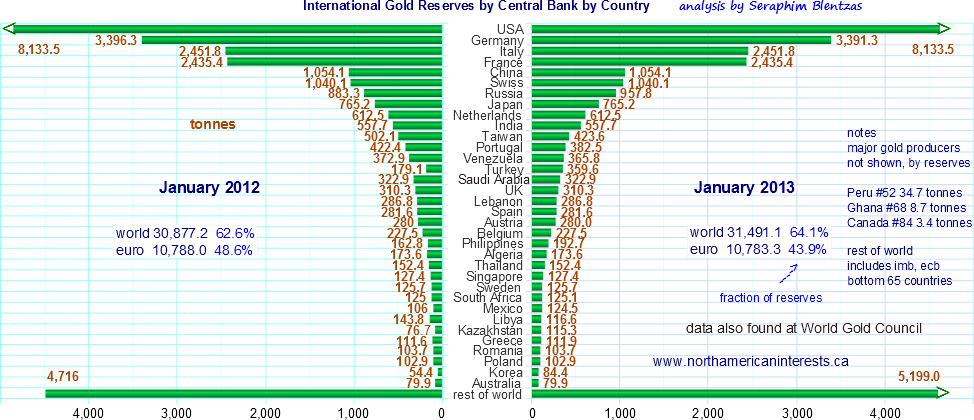
Russia purchased 20.73 tonnes of bullion in December - note also that in December gold prices were up for the first time in five months (+1%).  Makes Russian reserves fifth largest at 1210 tonnes.
Also notable - Ukraine held onto its reserves after selling 16 of 40 tonnes in Oct/Nov. 

Then there's the other central banks who cumulatively only became net buyers of gold since 2010 after 20 years of being net sellers.

Russia is key here - July through September 2014 it accounted for 59% of the 92.8t of net gold purchases by central banks.  Gold comprises just under 11% of Russian reserves up from 8% in 2013.  Those purchases allowed it to leapfrog China (1150 vs 1054).
Gold imports from HK by China were down last year but it was still the second highest on record at 813 tonnes.  Demand for gold should continue to increase into February as a result of Chinese new year festivities.

Don't Bet Against The Canadian Dollar !

I don't consider the current CDN/USD fxrate to be sustainable -  Beginning in 2016 oil prices are forecast to go up possibly by as much as 50% ($45->$65 per barrel).  Also note that Canada's federal government is starting to run a balanced budget while the USA has a severe, structural deficit which ultimately will lead the United States into a situation where it will be forced to run up high payments to foreign bondholders further weakening its long term outlook.

Don't Let Yesterday's Gold Selloff Turn You Off

- gold responds positively to durable goods numbers
- most global currencies are either under pressure (canada, australia, euro) or being deflated (asia) - this strengthens the US dollar in the near term but makes it increasingly vulnerable over the long term
- when the dollar shows any sign of weakness expect a big jump in precious metal prices
- Greek debt bailout 80 out of 240 billion is owed to Germany - If Greece doesn't pay up Germany will undoubtedly rethink its financial obligations to the Eurozone and that weakens Europe, its central bank and its structure.

Wednesday, December 31, 2014

2014 the year of Canadian Technology and Services Stocks CAE Inc, Constellation Software, CSU, OTEX, TSX (aviation training, software, growing companies, acquisitions)

CAE Inc (nyse:CAE) - aviation stocks, aviation training services, aerospace industry, healthcare sector

This year CAE Inc of Montreal became one of the world's largest simulation technology companies.  Its business is arguably the most diversified in the training services sector - at just under 200 locations in over 30 countries the company offers training services for pilots (civil aviation, defence), and manufactures key simulation technology for healthcare and security agencies.  50% of revenue comes from the sale of products (simulators and related technology) with the rest coming from services (aircraft operations training - over 100,000 civil and military personnel).

CAE Inc, constellation software inc, open text corporation, toronto stock exchange, security and defence, aviation stocks, aviation training, aerospace industry, ibm competition, organic growth, revenue growth, acquisitions, b2b services, software companies, nasdaq, market leading software, quarterly growth, dividends, growing companies, services stocks, diversified customers, healthcare sector, US Air Force, healthcare, critical software technology, software technology, tech stocks,


why this stock ?  it's low risk !
Among industry observers CAE enjoys a rock solid reputation.  It's extremely diversified (does not rely on a single market sector or customer), owns unique technology that has quickly become a mainstay in global aerospace training.  Business from healthcare is strong (hospitals and universities).
  • a global leader
  • the leading provider of commercial and helicopter aviation training services worldwide - second leading provider of business aviation services - market leader in key regions of China, India, South America
  • highly exposed to the growing defence and security sector (6% increase in revenue quarter ended September 30, 2014 - thanks to more activity in north amerca, europe and asia).
  • secured new contract to train the US Air Force
  • four consecutive years of revenue growth (2,114.90 2,035.20 1,821.20 1,630.80)
  • four consecutive years of dividend growth (0.22 0.19 0.16 0.15)
  • earnings up 38% last fiscal year (March to March) to $190 million.
nyse:CAE
1-year  6-months  3-months  1-month
1.2%  (1.4)%  6.8%  (1.2)%

Constellation Software Inc

2014 was a great year for Constellation Software Inc of Toronto (tsx:CSU).  The stock is up 60% for the year, bringing the market capitalization of the company to just under $8 billion and for good reason - in the latest quarter
- revenue is up a hefty 33% to $419 million (acquisitions accounted for all but 4%).
- earnings up 44% to $32 million vs $22m (per share $1.51 vs $1.05).
- adjusted ebitda up 73% to $100 million.
it's not just that last quarter either that has investors gleaming - over the last nine months adjusted ebitda is up 55% to $244 million.  net income up 26% -> $64 million.

what I like about the company 
it manufactures market leading software and has exposure to a number of industries (public and private).  the software it provides is critical making its products invaluable (meaning there are few if any alternatives - makes for more reliable customers).  Annual revenue recently surpassed $1 billion ! and quarterly growth is light years ahead of the competition (over 50%).  For a company with a market value over $7.3 billion it's an amazing feat to record 60% growth in stock price in just one year.
tsx:CSU    stock price change
1-year   6-months 3-months 1-month
 59.48%  27.02%       21.35%    4.19%

Open Text Corporation of Waterloo, Ontario  (b2b services, yahoo) - nasdaq:OTEX

2014 was a wonderful year for Open Text Corporation - It's New Year's Eve and year-to-date the stock up 28% to $58.26 (market cap at $7.2 billion on the nasdaq).  Like other Canadian success stories

Sunday, November 30, 2014

Retail Stocks To Watch During Holiday Season Hudson's Bay Company HBAYF, Target TGT, Sears SHLD department stores

Even though total sales during thanksgiving weekend were unchanged and black Friday sales were down 7%, the overall picture is not so bleak i) the official numbers released by the national retail federation do not include online sales (where major retailers like IBM, Target have already reported increases of nearly 10% versus the previous year) ii) sales are forecast to rise by 4% in november/december (holiday sales) which would be the biggest increase in three years.  Another thing benefiting Americans is a strong US dollar - this makes it easier for retailers to lower prices stateside.

US sales figures: black Friday : $9.1 billion -7%.  thanksgiving holiday : $3.2 billion +24%.

With Christmas only a month away let's look at a few stocks possibly benefiting from all this retail activity                     investing


Companies Benefiting From The Holiday Season


Target Corporation (TGT) - Canadian retail sales growth is strong (online sales up 23% nationwide), and with key competitors Canadian Tire CTC.A and Sears SHLD offering little in the way of online competition, there's good reason to expect a surge in sales at Target Canada.  Because Canada has one of the world's highest import fees, Target Canada is not exposed to as much online competition in the country as it is stateside. (Target competitors)
.. online sales matter : online retail sales up +22.6% in 2014.. 6.7% of all Canadian retail sales now occur online.

hudsons bay company, hbayf, hsbc, sears competition, nordstroms, shld, saks, fifth avenue, high end clothing, locations, new york city, montreal, stocks to watch, department store stocks, investment portfolio, long term debt, remortgage, reit, real estate investment trust, real estate stocks, target competitors, stock valuation, apparel, luxury brands, north america, department store competition, sears, holiday sales, online ecommerce, nrdc equity, robert baker, nordstrom, refinance debt,
Hudsons Bay (nasdaq:HBAYF) - HSBC commands a leading share in Canada's high end clothing market.  With Sears (nasdaq:SHLD) shifting its focus away apparel and into major appliances, hbayf could see an uptick in sales due to market share growth.  The company has a rich real estate portfolio - total retail asset value is $7.3 billion (including those in the US) which is twice the market valuation of the entire company !  Earlier this month its most coveted asset, the Saks Fifth Avenue flagship store in NYC was appraised at $3.7 billion which comes out to $1.3 billion more than what it paid for the entire company last year ! The CEO also has expressed interest in creating a real estate investment trust (reit) using company property.  hbayf - even if you exclude heavyweight Saks, group sales are healthy meaning the retail business adds value to the stock.  Also HBAYF is in the process of refinancing existing debt so as to reduce its long term debt load.  CEO Richard Baker is interested in opening new locations in high traffic areas - with more money coming in from the real estate side of the business he will be able to do this without the burden of short term debt (healthy quick ratio = less risk).
seraphim's advice - Richard Baker knows the retail market for apparel and is a real estate genius.  He's put the company in an enviable position - to grow throughout North America.  Saks, Hudson's Bay, Lord & Taylor are established brands with a long history - the fact that they have continued to do well when others like Sears are on life support, is a testament to the brand strength.  There's plenty of shareholder value to go around.
if you're looking for a company that maximizes shareholder value Hudson's Bay is the way to go - it took just a few years for privately held NRDC Equity Partners to turn a bankrupt chain of Canadian department stores into a money making asset.  The Zellers real estate assets that were sold for $2 billion two years ago didn't even touch the company's premier properties in Calgary, Montreal, and Vancouver.

Friday, October 31, 2014

Still Bullish On Gold & Coal, Alpha Natural Resources ANR Seabridge Gold SA Undervalued Radar Stocks Commodities

Alpha Natural Resources nyse:ANR - I made the mistake of not recommending this stock in my last post.  ANR is up 15% since October 11th.  Though the company's balance sheet still needs some tweaking, it's already showing signs of improvement (good quick ratio (short term equity to debt ratio), quarterly earnings losses not as bad as they used to be, metallurgical coal market is picking up / ANR is the leading producer of this type).

A third of company revenue comes from outside the US where demand will continue to be strong (doesn't have to deal with the Environmental Protection Agency EPA).

On reserves alone, the company's valuation is in the billions.  In 2011 after acquiring Massey Coal, the company was worth more than $10 billion - it is now a measly $434 million.  So what went wrong ?  the debt it absorbed when it acquired Massey was substantial and just after making the deal the company was faced with a series of write-downs which took away its profitability and damaged its reputation.  Some of that stems from an overall decline in the coal price, but not all of it ;

Rumors of an Obama war on coal have been rampant but have yet to come to fruition - in some states coal is just too important to simply phase out.  ANR is a major producer of thermal coal (used in electricity generation) and it relies heavily on sales of this in states like Kentucky - Obama recently mandated a 30% cut in carbon emissions by fuel burning power plants by 2030.  The easiest way for the states to accomplish this is to completely overhaul the way power plants generate electricity in states like Kentucky where thermal coal is the number one source of electricity.

However, given that public opinion is against it (full implementation will cost a quarter of a million jobs) and that democrats have a strong interest in winning Kentucky, it seems unlikely that those radical changes will be implemented anytime soon.  Add to that the higher costs associated with using natural gas (9c per kWh) and renewables (23c per kWh vs 4c for coal) to make electricity and you have a lot of reasons to invest in undervalued coal stocks like ANR.

The Gold Price Fell 5.4% In September Then Another 4.6% In October = Down US $126 In Just 61 Days !  


It's not just equities and the dollar that are pressuring the price of gold.

gold: not as popular among hedge funds


Total holdings by gold exchange traded funds (ETP) is now at the lowest level since 2009.
SPDR Gold Trust GLD is the largest physically backed gold ETF (two-fifths of industry holdings) - SPDR net holdings are at their lowest level since 2008.

It doesn't matter whether it's for jewellery or bullion, gold demand worldwide has been down for the better part of this year.
In the first and second quarters it was probably the price that turned consumers off (remained in a tight range between $1250 and $1310 after hitting $1385 in late March 2014), and with currencies such as the Indian Rupee and Canadian Dollar nearing four year lows against the greenback, the price may have just been too high.  In Q1 demand fell -26%, Q2 -16%.

A Reason To Be Bullish - India

The Indian festival of Diwali is a big reason India is the world's largest market for gold (#2 in 2013 but #1 in 2Q2014).  Last year, demand for gold during Diwali was down -33%, but this year jewelry sales are up +20% !

2014 Diwali : the price for 10 grams of gold averaged 27.5th rupees which is 15% less than in the previous year (32.5th).

Gold Price In US Dollars                                        
sept 2013 1392.25 -> 1326.50  -4.7%         sept 2014 1286.50 -> 1216.50 -5.4%
oct   2013 1290.75 -> 1324.00 +2.6%         oct  2014 1216.50 -> 1160.40 -4.6%

I'm Still Bullish

Though recent trends point to a bear market I remain somewhat bullish, at least for the long run.  US dollar, though up has been unsteady.  It appears to be stronger versus the key reserve currencies yuan, yen, Canadian $, Australian $, Euro, but I don't consider the current level to be sustainable.
US economic growth forecasts remain subdued, the effects of a strong dollar can wreak havoc on exports of US products since prices get more expensive in other currencies (why China has long maintained a low yuan policy).  Also, less exports tip the US trade imbalance even more in China's favor - this will stunt jobs growth as companies would rather pay employees in a cheaper currency. With QE3 down to only $15 billion a month from a high of $85 billion a year ago, any growth the US experienced earlier this year could disappear just as quickly as it appeared (less stimulus / harder for small businesses to borrow).

Tuesday, September 30, 2014

Electrolux eluxy Doubles US Market Share (whirlpool whr), Jaguar Tata Motors ttm Organic Growth China luxury vehicle market

If you're into retail stocks here's one to consider -  Electrolux eluxy aka Sweden's version of Whirlpool is taking the US by storm.  On September the 8th it acquired General Electric's (ge.n) appliances business for $3.3 billion (7 times ebitda multiple).  The move doubles Electrolux's market share in North America ($4.0 billion in sales -> $10.0 billion) putting it in direct competition with market leader Whirlpool whr.n.

Electrolux is already the number two player worldwide but this deal means a lot given that the US is the world's third largest market for sales of major appliances (2013: 28% of Electrolux sales come from Europe vs 32% stateside).. also note that American demand for appliances is estimated to grow by 9% in 2014 (up from previous estimate 7%).  And don't forget about the $300 million in synergy cost savings.. increased profitability right off the bat !  Less competition in the industry could mean higher prices - but even if that doesn't happen, Electrolex will undoubtedly have more control over the market price of its products.
jaguar unit sales, blackberry corporations, passport sales, major appliance stocks, the classic, electrolux competition,

Electrolux was doing well in North America even before this move - organic growth there is at 7% compared to 0.4% in Europe.  Whirlpool has a market value 40% greater than Electrolux despite having similar revenue;  Electrolux quarterly profit though has been wildly inconsistent.  Annual earnings are comparable to Whirlpool with the exception of 2013 ($827 million vs $93 million) but don't let that bother you - Electrolux is expanding rapidly in emerging markets (also a gradual move in production to low cost regions is estimated to boost 2014 earnings by a hefty $284 million) and the costs associated with that process have been high but, by establishing itself early in those regions Electrolux is setting itself up for the future (and gaining an edge over the competition).

Tata Motors is growing.. very fast


Tata Group (private) is perhaps India's most diversified company.  It sells beverages such as coffee and mineral water, generates electricity for public use, mines salt, manufactures automobiles (both high and low end), provides telecommunications services in India (Virgin Mobile India), is a service company (hotels, airasia, financial services).  Its largest publicly traded subsidiary is Tata Motors nyse:ttm.  In 2012 the auto division was worth $15.2 billion, today it's at $25.2 billion (all organic growth !).

Despite no major acquisitions over the last few years, auto division Tata Motors finally appears to have an asset capable of providing organic growth.  In 2008 it acquired struggling automarker Jaguar Land Rover from Ford for $2.3 billion (today the Jaguar unit represents 95% of Tata Motors' valuation which translates into $23 billion !).  The deal instantly gave Tata a foothold in overseas markets (a plus for a company looking for international recognition) but unbeknownest to Tata, sales at Jaguar Land Rover didn't need much of a push to take off  - between 2009 and 2013 auto sales doubled to 425,000 units ; with 18.8% yoy growth last year.  In 2013 global sales of Jaguar models was up 37% (North America +50% vs -6% the previous year).  Demand from China will have a tremendous impact on future growth (is currently the leading market for Jaguars; will push unit sales up to 1 million by 2020).  Last fiscal year China accounted for 24% of Jaguar Land Rover sales vs 21% the year before.
China is embracing Tata Motors and why not ?  The country has low current luxury ownership rates, rising proportion of affluent individuals, and a strong affinity for premium brands.  
Currently Jaguar represents 7% of all luxury vehicle sales in China (luxury vehicle market); estimates show China's total demand will reach three million by the end of the decade, Tata will account for at least 250,000 units, if its share increases then expect auto sales to rise markedly.
more..  Tata makes electric vehicles and owns South Korea's second largest manufacturer of heavy commercial vehicles (Daewoo has been a part of Tata Group since 2004).  On the flip side Tata Motor's low end passenger vehicle business has fared poorly (sales in India of its own makes including the Tata Nano and Zest are down 33% so far this year 88th -> 58th) but the company is committed to reviving it and has the assets to accomplish that ($7 billion cash, a parent company that both operates leading European and Indian engineering technical institutes and even mines/fabricates the steel used in its cars).

Tata Motors stock price change : 1 mo -10%, 3mo +13%, 6mo +9%

Magna International Expands In India (nyse: MGA)


The largest auto parts marker in North America makes Asia a priority
September 29, 2014 - Magna announces plans for two new facilities to be built in Gujarat, India.  The plants will produce seat systems and body and chassis systems.  Magna already produces various parts in India for GM, Ford, and Nissan.

Sunday, August 31, 2014

USA loses Burger King BKW & Petro Dollars first rouble oil shipment, Tim Hortons Merger Good For Loonie, gold demand

On August 27 rumblings of a Burger King corporate inversion made the headlines but its significance is far outweighed by another event that transpired the same day:  Russia's Gazprom OGZPY ships the first tanker of oil (80,000 barrels) ever to be sold internationally in a currency other than the US dollar.  The destination ? China via the Siberian Pacific Ocean pipeline connection.

A Sign Of Things To Come - veering away from Petro Dollars

In addition to this, two other shipments headed for Europe are also reported to involve roubles.  If you don't have roubles don't fret - Gazprom also accepts Chinese Yuan !  It's unclear as to whether or not this move was made in response to recent sanctions since China and Brazil are also attempting to do the same thing.

Russian Rouble forex rate falls to Record Low

On August 29 the rouble fell to 37:1 versus the US dollar, the lowest exchange rate seen since the Russian currency was restructured in 1998.

America Continues To Lose Big Name Companies - Burger King a Canadian Restaurant Chain ?

The second last weekend of the summer couldn't have ended soon enough for Burger King BKW and InterMune ITMN - mergers and acquisitions

California based InterMune a leader in therapies targeting lung conditions, was acquired by Switzerland's Roche RHHBY for $8.3 billion.
The same day it was also announced that Burger King is in talks to buy Tim Hortons THI in a corporate inversion - merged company uses the move to change country of domicile - New Canadian headquarters presumably will be in Oakville.

Oakville has the sixth-lowest business tax rate among two-dozen Greater Toronto Area municipalities, will be scouted as a potential location.  Last year, federal and state income taxes represented 34% of profits at Burger King.

gold sales, gold supply, gold demand, mining, metals report, gold price, chinese demand, china consumption, india demand, india gold, jewelry demand, gold coin, gold bars, jewellery, wgc
One is acquiring the other for $11.4/$C12.5 billion ($3 billion in finance from Berkshire Hathaway gives it a preferred stake which pays a higher dividend yield) or $94.05 per share - $65.50 in cash and 0.8025 per share of the new company for each share they own

... however, Canadian taxes may not be the issue

Daniel Schwartz, Burger King’s C.E.O. added, “We don’t expect there to be meaningful tax savings, nor do we expect there to be meaningful changes to our tax rate.”  Last year Tim Hortons effective tax rate was virtually the same as the US rate of 27.5%.

Other reasons why the company is relocating - Two-thirds of the combined company's revenue will come from Canada, with 20% from the U.S. and 13% from the rest of the world.  Tim Hortons is underleveraged meaning they can borrow against those assets -> this will enable the new company to make even more acquisitions !  

What allows BKW to transfer its headquarters to Canada is thisunder US tax law, if the US company transfers more than 20% of its shares to the foreign firm it can switch its tax jurisdiction.

The Canadian corporate tax rate of 26% compares favorably to the 35% rate stateside - last year Burger King paid a rate of 27%.  Canada has the second lowest tax rates in the G7.  "total tax costs are up to 40% lower in Canada versus the USA".   you see, overseas income is only taxed when it's brought back to the country of domicile.

Burger King is undergoing tremendous growth abroad, something that Tim Hortons has been trying to do over the last few years, unsuccessfully - 859 of the 879 non-Canadian locations are in the United States.
BKW is the larger of the two brands (13,000 restaurants vs 4600 Tim's) but the bulk of its restaurants are franchised, meaning corporate revenue isn't as strong as it is at Tim Hortons (for instance Burger King Canada is not even a part of the company ! it was sold by 3G Capital back in 2013).  Although BKW net earnings doubled last year (117.7-> 233.7 million) it has yet to match that of Tim Hortons ($424.37 million, up 5% in 2013).

After the deal is completed, Burger King can leverage Tim Hortons ability to tap the breakfast, coffee and snack market, making it more competitive with McDonald's.

Tim Hortons THI has always been a great investment - company brass have always been open to partnerships with other fast food industry players.  Previously they were involved Cold Stone Creamery and before that, Wendy's.   Some say that the ice cream partnership didn't work out (cost Tim's $19 million to terminate the deal but it did last a few years) however if done right, this one could actually work !
Brazil's 3G Capital will be the company's largest shareholder (51% of combined company; was 70%  pre-merger).  3G also controls iconic Canadian beer maker Labatt Breweries.